
It matters because the history explains both the purpose of the part and why converter designs differ by era, engine type, and emissions standard.
The first car was founded over 130 years ago. Still, it took over 20 years to start mass production. By that, we mean Henry Ford and his Model T. More than a century ago, everyday transport became normal for millions of people. That was a huge step forward for mobility, work, trade, and daily life.
However, more vehicles also meant more exhaust. As car ownership grew, air pollution turned into a real and visible problem. The original article was right to focus on Los Angeles in the mid-1950s. Even on a clear day, people could see the effect of exhaust and industrial emissions hanging over the city.
That is why catalytic converter history is more than a technical timeline. It is really the story of how the automotive world reacted when the benefits of mass transport collided with public health and environmental pressure.
If you want the chemistry behind the device after reading the history, Blancomet also has a practical guide on how a catalytic converter works.
Catalytic converters were designed to reduce harmful gases in engine exhaust before those gases left the tailpipe.
Internal combustion engines produce several unwanted by-products. The main targets are carbon monoxide, unburned hydrocarbons, and nitrogen oxides. In simple terms, these gases and compounds contribute to dirty air, smog, and health risks.
The original article described the problem well: once cars became common, pollution from automobile exhaust pipes could no longer be ignored. That point is still the heart of the story. A catalytic converter was not invented as a performance part or a convenience part. It was created to answer a pollution problem.
The U.S. Environmental Protection Agency describes catalytic exhaust technology as a way to reduce harmful engine emissions by promoting chemical reactions in the exhaust stream. That basic idea still defines the part today.
It mainly targets carbon monoxide, hydrocarbons, and nitrogen oxides.
Those pollutants come from the combustion process inside the engine. A converter does not stop them from forming in the cylinders. Instead, it treats them after combustion, inside the exhaust system, before they enter the air around us.
The first automotive catalytic converter concept is most closely associated with the French engineer Eugene Houdry.
Around the 1950s in the United States lived a French mechanical engineer, Eugene Houdry, who was already well known for his work in catalytic oil refining. He became deeply concerned about the effect of air pollution from cars and industry on human health. That concern pushed him to work on exhaust-cleaning technology.
According to Britannica, Houdry developed the first catalytic converter for automobiles and received a U.S. patent for the concept in the 1950s. The original article mentioned patent number 2742437, and that remains an important part of the story because it marks one of the earliest formal steps toward practical vehicle emissions control.
The original version also referred to Houdry’s Oxy-Catalyst company. That fits the wider history. His aim was simple in principle, even if it was difficult in practice: build a device that could lower the harmful output of engines.
Early converters struggled because fuels, engine systems, and operating conditions were not yet suitable for long-term automotive use.
Back then, the technology was primitive compared with what drivers know today. Early units were more useful on industrial equipment and certain controlled applications than on ordinary passenger cars. The original article noted that some early use was on warehouse forklifts running on low-grade, non-leaded fuel. In those settings, the technology had at least some practical value.
Passenger cars were a different story. Many vehicles still used leaded petrol, and that was a major barrier. Lead damaged the catalyst very quickly, which meant the converter could lose effectiveness or fail outright. In other words, the idea was sound, but the wider automotive ecosystem was not ready for it.
That is one reason the early invention did not instantly become standard equipment. The part existed before the market conditions needed for mass adoption existed.
Unleaded fuel allowed the catalyst to stay active instead of being poisoned by lead.
This was a technical turning point and a market turning point at the same time. Once fuel changed, converter durability and real-world usefulness improved. That opened the door for tighter emissions control across large numbers of road cars.
Early designs focused on converting the worst exhaust compounds into less harmful ones, but they were limited by the engines and fuels of the period.
The original article explained that early converters aimed to clean toxic materials created during combustion. In simple terms, carbon monoxide could be converted into carbon dioxide, while hydrocarbons could be converted into water and carbon dioxide. That basic chemistry remains central to converter operation.
Those first designs worked better in some industrial settings, such as smokestacks and controlled equipment, than in ordinary passenger vehicles. That does not make them unimportant. In fact, these early attempts proved that catalytic exhaust treatment could work. The main challenge was adapting the concept to the harsh, varied conditions of normal road use.
The 1970s brought the combination that catalytic converters needed: stricter emissions rules, better engineering, and a shift toward unleaded fuel.
This is where the history moves from invention to large-scale adoption. The original article rightly pointed out that a decent car adaptation only arrived in the mid-1970s. That period matters because governments were demanding much cleaner exhaust, and car makers had to respond fast.
Instead of treating emissions control as an optional add-on, manufacturers had to design around it. That changed the converter from an experimental device into a core emissions component. Once regulations became tighter, the technology moved from workshop curiosity to mainstream automotive necessity.
The modern three-way catalytic converter is widely credited to Engelhard researchers John J. Mooney and Carl D. Keith.
The original article mentioned Dr. Carl D. Keith, and that is an important part of the story. The fuller history usually credits both Mooney and Keith for the three-way design that became the basis for modern petrol vehicle converters.
This mattered because the new system did more than the earlier oxidation-focused designs. It could address three major pollutant groups in one unit: carbon monoxide, hydrocarbons, and nitrogen oxides. That leap made the converter far more effective for real-world road use.
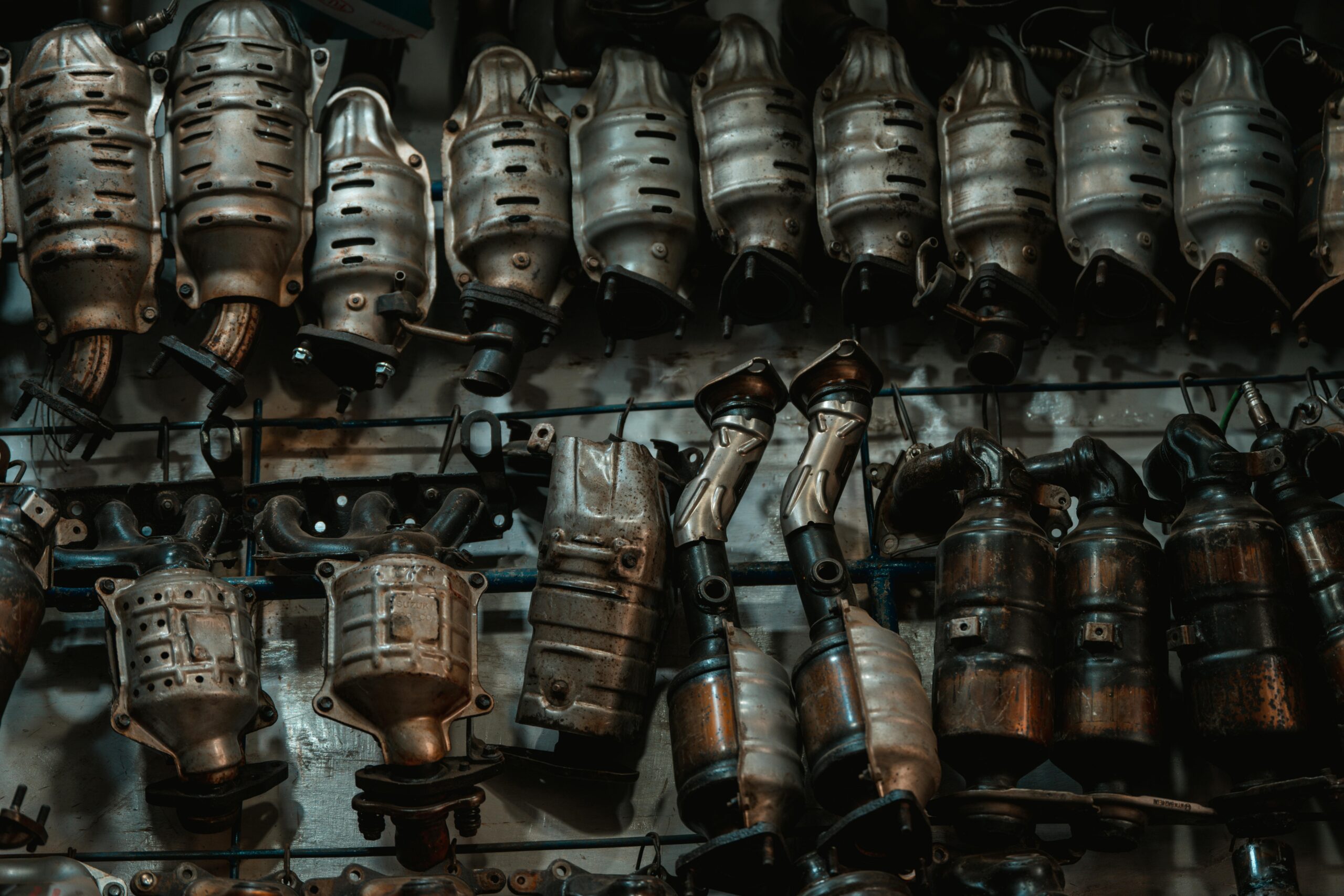
It changed emissions control by letting one exhaust component handle several harmful gases at once.
In practice, that meant the converter could transform carbon monoxide into carbon dioxide, reduce hydrocarbons into water and carbon dioxide, and convert nitrogen oxides into nitrogen. That broader treatment range is why the three-way catalyst became such a milestone in automotive design.
For drivers, the change was mostly invisible. The part sat under the vehicle, out of sight, doing its work through chemistry rather than moving parts. For the industry, though, it was a major shift. Cleaner exhaust was no longer just an ambition. It was built into the vehicle.
The short answer is that the history moves from mass motoring, to pollution awareness, to invention, and then to broad adoption under stricter emissions rules.
The table below gives a simple overview of the biggest steps.
| Period | What happened | Why it mattered |
|---|---|---|
| Early mass motoring era | Cars became more common for daily transport. | Exhaust pollution grew with vehicle numbers. |
| Mid-20th century | Smog and air quality problems became more visible in major cities. | Public pressure for cleaner vehicles increased. |
| 1950s | Eugene Houdry worked on the first automotive catalytic converter concept. | The basic solution for exhaust treatment was established. |
| Early practical phase | Converters saw limited use in controlled or industrial applications. | The idea worked, but passenger cars were not yet ready. |
| Mid-1970s | Unleaded fuel and tighter emissions rules supported automotive adoption. | Converters became viable on mainstream road cars. |
| Modern era | Three-way catalytic converters became standard on many petrol vehicles. | Exhaust treatment became a normal part of vehicle design. |
It has evolved from simple early exhaust-cleaning concepts into more effective, application-specific systems built for modern emissions standards.
The biggest change was not just better chemistry. It was integration. Early converters were trying to prove a principle. Later converters became part of a complete emissions-control system, working alongside engine tuning and fuel system changes.
That is also why not every converter looks or functions exactly the same. Vehicles use different layouts, sizes, and emissions setups. If you want a broader view of design differences, Blancomet’s article on types of catalytic converters is a useful next read.
It matters because the age and design of a converter affect identification, replacement choices, failure patterns, and end-of-life handling.
From a recycler’s point of view, history explains why units from different eras can vary so much in form, internal design, and intended application. A converter from an older petrol car is not automatically the same as one from a newer vehicle, even if both serve the same broad purpose.
This is one area where the original article can be expanded in a practical way. Understanding the development path helps owners ask better questions. Is the converter original to the vehicle? Was it designed for an early emissions system or a later one? Does the unit belong to a specific exhaust layout? Those details matter when diagnosing issues or handling a used component responsibly.
For companies like Blancomet, that historical knowledge supports better sorting, identification, and compliant catalytic converter recycling. The part is not just scrap from an exhaust line. It is the result of decades of engineering built around cleaner air.
No, they did not. The path from invention to everyday use took decades.
That long gap is one of the most important lessons in this story. Eugene Houdry’s work came well before converters became normal on passenger cars. The delay was not because the idea lacked value. It was because real adoption needed the right fuel, stronger emissions pressure, and a design robust enough for daily driving.
So when people ask about the history, the honest answer is not a single date. It is a progression: first the pollution problem, then the invention, then the technical barriers, and finally the mass-market breakthrough.
The history of the catalytic converter begins with the rise of mass car use and the pollution that followed. Early cities saw the effect in the air, and engineers like Eugene Houdry began searching for a practical way to clean exhaust before it reached the atmosphere.
Early converter designs proved the concept, but road cars were not yet ready. Leaded petrol damaged catalysts, and the wider vehicle system still needed to evolve. The real breakthrough came in the 1970s, when stricter emissions rules and unleaded fuel made broader adoption possible.
The three-way catalytic converter then changed the game by treating carbon monoxide, hydrocarbons, and nitrogen oxides in one system. That design shaped the modern emissions-control approach used on many petrol vehicles for decades.
Today, this history still matters. It helps drivers understand why the part exists, why different converters vary so much, and why responsible end-of-life handling remains important. In short, catalytic converter history is the story of how the automotive industry learned to make necessary transport cleaner without changing the core role of the car itself.
The first automotive catalytic converter concept is linked to Eugene Houdry in the 1950s. However, widespread use on passenger cars came later, especially from the mid-1970s onward.
Eugene Houdry was a French engineer and catalytic refining expert who worked on one of the earliest automotive catalytic converter concepts. His work helped lay the foundation for later emissions-control technology.
Leaded petrol damaged the catalyst inside early converters. That made the units far less durable and limited their use in everyday road cars.
A three-way catalytic converter treats three major pollutant groups in exhaust: carbon monoxide, hydrocarbons, and nitrogen oxides. It turns them into less harmful substances before they leave the tailpipe.
It helps explain why converters were invented, how emissions systems developed, and why different units vary by vehicle and era. It also gives useful context for repair, replacement, and responsible recycling.

5 Rosemount Park Drive
Rosemount Business Park, Ballycoolin Dublin, D11 FVH2, Ireland