
This article covers: what changed in UK workplace recycling rules for 2025 and 2026, which non-ferrous metals hide in everyday business waste, why small electricals now matter, how much money SMEs typically leave in the bin, how to set up a simple compliant separation system, and when to choose a specialist recycler over a general waste contractor. It is written for owners and managers who have already searched for scrap yard metal near me and want a clearer answer than a generic listing. By the end, you will know which non-ferrous items in your bins may be worth real money, and how to stay compliant without adding extra hassle.
UK workplace recycling rules now expect businesses to separate more materials at source, and metal is part of that picture. For SMEs, that means binning mixed waste and hoping for the best is no longer a safe default.
In England, the Simpler Recycling rollout has made separate collection of core recyclable materials a clear workplace duty, with different timing for firms with 10 or more full-time equivalent staff and for micro-businesses. According to GOV.UK, workplaces in England need arrangements for recyclable waste streams such as metal, rather than treating everything as residual waste.
Wales already has workplace recycling duties, and the rules are tightening further for some items. According to GOV.WALES, Welsh workplaces must separate key recyclable materials, and small waste electrical and electronic equipment also comes into scope from 2026.
Scotland has had workplace recycling rules for years, so firms with sites there should not assume an England-only setup will cover them. Northern Ireland businesses should also review local site arrangements rather than copying a policy from another UK nation and hoping it fits.
In plain English, better separation of metal offcuts, cans, cable, and small electricals is now expected. If your business ignores that, the risk is not just environmental. Non-compliance can mean fines, repeat collections, lost staff time, and even hourly investigation charges on top of the original waste issue.
It is any metal stream that does not rely on iron as its main content. In day-to-day business waste, these items often look small, messy, or mixed, which is why they get missed.
Non-ferrous metals commonly found in SME waste include aluminium, copper, brass, lead, and zinc. They show up in cable, fittings, trims, pans, fixtures, machine parts, and old electrical items. If your team needs a refresher on what is what, this practical guide to identifying and sorting non-ferrous metals is a useful place to start.
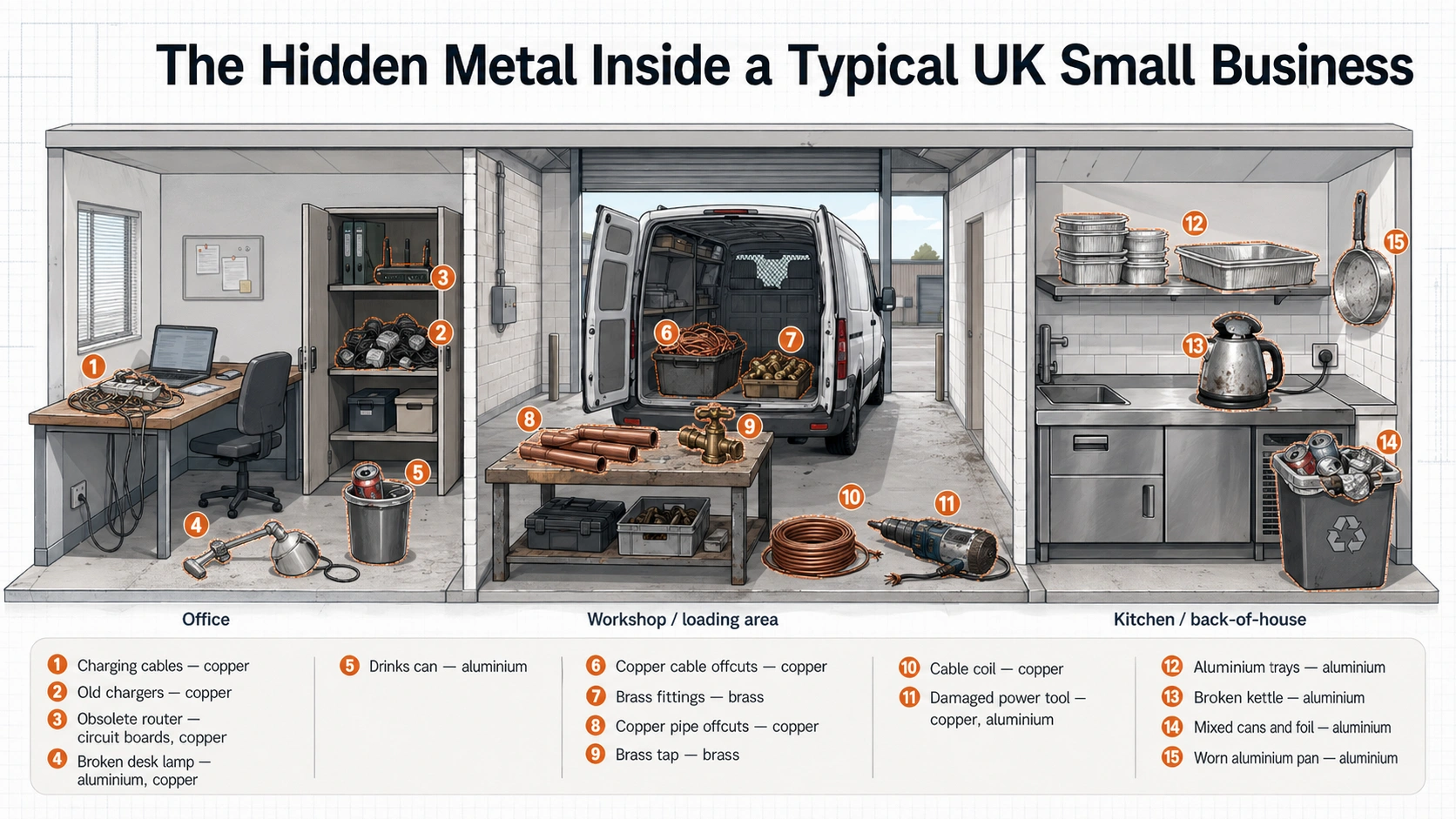
They usually hide in the places staff stop noticing. That means cable tails in vans, broken fittings in site buckets, foil trays in kitchens, and old chargers in office cupboards.
Offices often create more recoverable metal than managers expect. Think laptop chargers, dock cables, server-room leads, broken desk lamps, and old IT accessories. Trades generate even more. Electricians, plumbers, HVAC teams, and fit-out crews leave behind cable offcuts, copper pipe, brass fittings, taps, and mixed metal parts after almost every job. Hospitality sites add aluminium trays, beverage cans, kitchenware, and worn fixtures. Light manufacturing sites produce turnings, offcuts, stamped parts, and rejected components.
| Business type | Typical items | Why they get missed | Better route |
|---|---|---|---|
| Office | Chargers, cable, desk lamps, IT accessories | Small items end up in desk-side or clear-out bins | Separate box for small electricals and clean metal parts |
| Electrical and plumbing trades | Copper cable, pipe offcuts, brass fittings, taps | Job waste leaves site in mixed sacks or van tubs | Dedicated containers in vans and at the yard |
| Hospitality | Aluminium trays, foil, cans, worn pans, fixtures | Back-of-house teams focus on speed, not sorting detail | Clearly marked kitchen and storeroom bins |
| Light manufacturing | Offcuts, rejects, stamped parts, cable, housings | Metal is mixed with packaging or general production waste | Stream-by-stream segregation near the process line |
Once staff see a few examples, the habit changes fast. A simple crate marked for clean non-ferrous material can stop good metal being spoiled by plaster, food residue, packaging, or general rubbish.
The aim is not to create more admin. It is to stop valuable scrap metal being buried in mixed waste where it earns nothing and creates extra disposal cost.
Small electricals matter because they often contain recoverable metal and they are increasingly covered by workplace recycling rules. If they stay in general waste, you lose both compliance control and material value.
Many SMEs throw away small electrical items without thinking about them as a metal stream. Chargers, extension leads, damaged power tools, routers, kettles, fans, old handsets, monitors, and cable bundles all show up during office moves, refurbishments, call-outs, and stock clearances.
These items are easy to miss because they do not look like loose metal. They look like clutter. Yet inside, they may contain copper, aluminium, brass, and other recoverable parts that belong in a dedicated stream rather than a general waste bag.
The common problem items are the ones staff clear in a hurry. They are often small, tangled, or mixed with plastic.
For SMEs, the fix is simple. Do not let these items drift into general waste or mixed dry recycling. Give them a named stream and a clear collection route.
Often, more than they think. The loss comes from two directions at once: missed recovery value and higher general waste cost.
Most SMEs do not produce a mountain of metal in one day. They produce a steady trickle. That is exactly why it gets ignored. A few copper tails after each call-out, a box of faulty chargers after an IT refresh, worn brass fixtures from maintenance, or aluminium kitchen kit from routine replacement can seem too minor to sort. Over a month or a quarter, however, that trickle becomes a repeat stream.
This is part of a wider shift across the UK and Ireland. More tradespeople, small business owners, and even individuals are now treating non-ferrous scrap as a reliable side income line, especially as prices for clean copper, brass, and aluminium have stayed firm going into 2026. For a closer look at how that is playing out at ground level, this overview on how people in the UK and Ireland turn non-ferrous scrap into extra cash in 2026 is a useful read alongside this guide.
There is also the hidden saving on the waste side. When you strip metal and small electricals out of mixed waste, bags get lighter, bins stay cleaner, and less recyclable material is lost in residual collections. That can support cleaner reporting for customers, landlords, and ESG reviews as well.
When owners start searching scrap collection near me, it is usually because those small bits have turned into a regular operational cost.
| Business type | Material that builds up | What happens if it is binned | Better outcome when separated |
|---|---|---|---|
| Electrician | Cable tails, fittings, conduit parts | Mixed job waste grows quickly and hides recoverable metal | Cleaner site waste and a regular saleable stream |
| Small workshop | Offcuts, rejects, machine parts, cable | Metal contaminates general or mixed recycling loads | More accurate segregation and easier collections |
| Refurbishment contractor | Pipes, taps, trims, old fixtures | Skip waste carries value away with bulky debris | Sorted material is easier to store and move |
| Cafe or hotel kitchen | Cans, trays, foil, pans, broken small appliances | Back-of-house bins fill with recyclable material | Lower residual waste pressure and cleaner reporting |
The real lesson is simple: if a material appears every week, it deserves its own route. SMEs do not need huge volumes to make that worthwhile.
Start small and keep it visual. Most businesses can fix the problem with a three-step setup that fits normal staff routines.
That is one system serving two goals at once: cleaner compliance and better recovery.
Start with the streams that are frequent, easy to recognise, and often thrown away by mistake. These usually include cable, pipe, fittings, cans, trays, small fixtures, and old electrical items.
Walk the site for 20 minutes. Look at the kitchen, workshop, van return area, maintenance room, office clear-out cupboard, and goods-in or returns area. Ask staff what they throw away every week. You do not need a long policy document to start. You need a short list of repeat items.
Put them at the point of waste, not in a far corner nobody visits. If the correct container is awkward to reach, staff will keep using the nearest mixed bin.
Use plain labels such as “Cable only”, “Clean metal fittings”, “Small electricals”, or “Metal cans and trays”. Keep contamination rules short. A one-line note like “No food, no plaster, no general rubbish” works better than a dense sign.
Match collection to how fast material builds up, not to a fixed habit. Some firms need a regular pick-up, while others do better with a simple drop-off routine when a crate is full.
Review after the first month. If one stream stays clean and fills quickly, expand it. If another attracts too much mixed waste, improve the label or move the container. Most SMEs do not need a complicated system. They need a visible one that staff can follow on a busy day.
Use a specialist when metal is a repeat stream rather than a one-off clear-out. A dedicated recycler can usually sort, grade, and document metal loads more carefully than a general mixed waste service.
A general waste contractor may be fine for bulky mixed site waste. However, once your business has regular cable, pipe, brass, aluminium, or small electrical streams, a specialist route often makes more sense. The material stays cleaner. The collection method fits the waste type. Records are usually clearer for duty-of-care and ESG reporting.
If you are reviewing suppliers across England, Scotland, Wales, or Northern Ireland, searching for scrap metal collection near me is only step one. Ask whether the recycler handles non-ferrous streams separately, can deal with small electrical items where needed, and provides straightforward paperwork for your files.
Ask short, practical questions. The answers will tell you very quickly whether the service fits your site.
That last question matters more than many managers realise. Staff will always find awkward items. If the recycler gives a simple rule for those cases, contamination stays lower and compliance gets easier.
Review your waste setup now, not after a failed audit or a missed collection. A short site check this month can prevent a much more expensive tidy-up later.
Start with one location if your business has several. List the metal and small electrical items you create. Place containers where the waste appears. Train staff with five-minute toolbox talks or kitchen briefings. Then review your collector or recycler arrangement against what the site actually produces.
For firms operating in more than one UK nation, keep one simple principle in mind: separate first, then adapt to local rules. That is far easier than rebuilding a mixed system later. England, Scotland, Wales, and Northern Ireland may not follow the same timetable, but clean separation of metal and small electricals is a sensible base in all cases.
If your business is in England, Scotland, Wales, or Northern Ireland and you are updating waste processes for 2026, talk to Blancomet about a non-ferrous metals and WEEE collection that turns a new legal obligation into a new income stream.
For SMEs, the 2026 waste changes are not just about compliance. They are also about spotting value that has been sitting in plain sight. Cable, brass fittings, aluminium trays, old chargers, damaged tools, and other small items often leave the site as rubbish when they could be separated, documented, and recovered. A simple setup, clear labels, and the right recycling partner can cut confusion fast. If your team needs help creating a practical route for metal and related electrical waste, a specialist non-ferrous service from Blancomet can make the process much easier.
1. Does my UK business need a scrap metal dealer’s licence to sell its own scrap?
No. A Scrap Metal Dealer’s Licence is only required if your business is buying or selling scrap metal as a commercial activity, such as a yard or mobile collector. If you are an SME selling off your own off-cuts, fittings, cable, or end-of-life equipment to a licensed buyer, you do not need a personal licence. You do, however, need to make sure the recycler you use is licensed by their local authority under the Scrap Metal Dealers Act 2013.
2. Can my business be paid in cash for scrap metal in the UK?
No. Cash payments for scrap metal have been illegal in the UK since 2013. Any licensed dealer must pay by bank transfer, cheque, or another fully traceable method. If a buyer offers cash, that is a clear sign they are operating outside the law – and selling to them puts your business at risk under duty-of-care rules, regardless of who initiated the payment.
3. What ID and records do I need when selling scrap metal as a business?
Licensed dealers must verify the seller’s identity at the point of sale, so expect to provide photo ID such as a passport or driving licence, plus proof of address dated within the last three months. The dealer is required to keep transaction records for at least three years, including the type, weight, and origin of the metal. For your own files, keep waste transfer notes and any duty-of-care paperwork the recycler provides – these are essential for ESG reporting and any future inspection.
4. Which non-ferrous metals hold the most value in 2026?
Copper continues to be the highest-value common scrap metal, particularly clean bright wire and tube grades. Brass and aluminium follow, with grade and cleanliness having a major effect on the price your business is offered. Mixed or contaminated loads always sell for less, which is why even basic separation – keeping copper away from brass, removing insulation where practical, and keeping food or plaster off everything – directly increases what you earn.
5. Can my business take WEEE or small electricals to a household recycling centre?
No. Household waste recycling centres are not permitted to accept business WEEE in most cases, and they cannot issue the evidence notes your business needs to prove compliant disposal. Small electricals from a workplace – chargers, broken kettles, extension leads, IT accessories, damaged tools – need to go to an Approved Authorised Treatment Facility (AATF) or be collected by a licensed WEEE carrier. This is also the route that protects you under GDPR if any item could hold data.
6. What happens if my SME ignores Simpler Recycling and keeps everything in general waste?
Non-compliance can lead to enforcement action from the Environment Agency or your local authority, including compliance notices and fines. Beyond the formal penalty, the practical cost is usually higher: rejected collections, repeat visits, hourly investigation charges, and lost recyclable value bagged with general waste. For most SMEs, basic separation costs almost nothing to set up and removes the risk entirely.
7. Do micro-businesses with fewer than 10 staff have to follow the new workplace recycling rules?
Yes, although the timetable is more generous. In England, businesses with 10 or more full-time-equivalent staff are already in scope of Simpler Recycling, while micro-businesses must comply by 31 March 2027. Wales, Scotland, and Northern Ireland operate on different schedules, but the underlying expectation – separating recyclable materials including metal – applies across all four nations. It is far easier to set up a clean system now than to retrofit one under deadline pressure.
8. What is mandatory digital waste tracking, and does it affect my SME?
From April 2026, businesses that produce, handle, or dispose of waste in the UK must log waste movements on a centralised digital platform. The aim is to cut waste crime, improve transparency, and support circular-economy goals. For most SMEs the practical impact is minimal as long as you use a licensed recycler – the operator handles the bulk of the digital reporting – but you may be asked for slightly more detail at weigh-in, and you should keep your own copies of waste paperwork to match the digital record.

5 Rosemount Park Drive
Rosemount Business Park, Ballycoolin Dublin, D11 FVH2, Ireland