
Because the car may still feel usable, while the cost of fixing emissions faults can be hard to justify on an older vehicle.
That tension is what makes this decision tricky. A converter fault can mean a warning light, poor performance, more fuel used, and the risk of failing an MOT. At the same time, plenty of older petrol, diesel, and hybrid cars still have years of practical use left if the rest of the vehicle is sound.
The confusion gets worse because policy headlines can sound harsher than they are. Rules linked to Euro 7-style standards are aimed at new vehicles coming to market, not at forcing every older car off the road at once. Still, those changes affect how people think about keeping an ageing car, especially when a major emissions-related repair lands on the kitchen table.
A common quoted range is 70,000 to 100,000 miles. That is a useful guide, but it is not a promise.
Some cars reach that range with no trouble. Others see trouble sooner. The big difference is how the car is driven and how well the engine has been maintained. A healthy engine is kind to the exhaust system. A poorly running one is not.
No. Mileage gives you a rough range, but wear depends just as much on heat cycles, short journeys, and engine condition.
A car that mostly does steady motorway miles may age the exhaust more gently than a low-mileage car used only for cold starts and five-minute trips. Heat matters. The unit needs to get hot enough to work well. Constant cold running can leave deposits behind and stress the system over time.
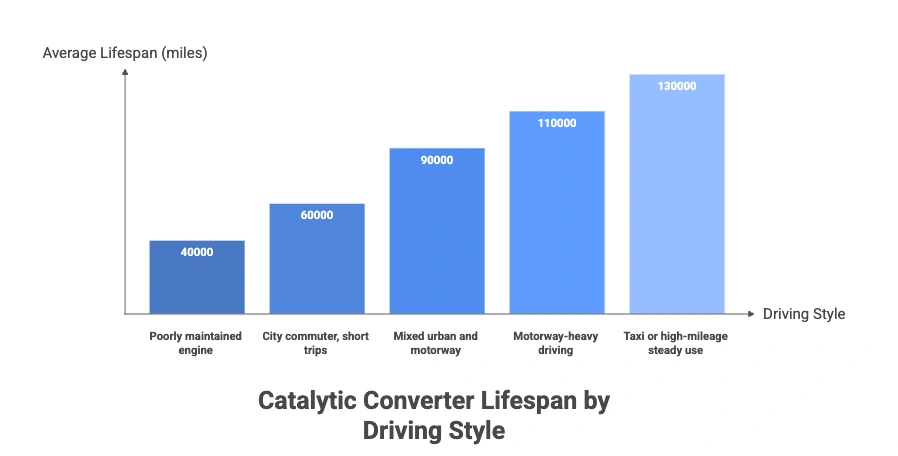
Repeated short trips, ignored warning lights, and engine faults are some of the biggest causes of early failure.
Misfires can send unburned fuel into the exhaust. Oil burning can coat the internal material. Coolant leaks can poison the active surface inside the unit. Even road damage matters, especially on lower cars that catch speed bumps or rough kerbs. If you want a deeper checklist, Blancomet has a useful guide on when a converter should be replaced.
The usual signs are a warning light, loss of power, poor fuel economy, unusual heat, and a car that feels strangled under load.
These signs do not always prove the unit itself is dead. An upstream engine problem may be the real cause. That is why diagnosis matters before you spend money.
A simple way to think about what is the function of catalytic converter is this: it helps convert harmful exhaust gases into less harmful emissions before they leave the tailpipe. When it stops doing that job well, the symptoms often show up in how the car breathes and performs.
If you are still wondering what’s the purpose of a catalytic converter, the everyday answer is simple. It helps your car control emissions and stay road-legal when the rest of the engine is in good shape.
Take a warning light, a sudden drop in power, or a strong rotten-egg smell seriously straight away.
Those signs often mean the exhaust after-treatment system is under stress. A blocked catalytic converter can make the car feel flat at higher revs, as if it cannot exhale properly. In some cases, the exhaust may run hotter than normal, which can lead to bigger damage if you keep driving without checking it.
| Sign | What it may point to | What to do next |
|---|---|---|
| Engine warning light | Emissions fault, sensor issue, or reduced converter efficiency | Get a scan before buying parts |
| Loss of power under load | Restriction in the exhaust or another engine fault | Check exhaust back pressure and engine condition |
| Poor fuel economy | Engine over-fuelling or inefficient exhaust treatment | Inspect spark, fuel, and sensor health |
| Rattling from underneath | Internal material may be breaking up | Inspect the casing and supports soon |
| Strong sulphur smell | Exhaust treatment not working as it should | Book diagnosis and avoid long delays |
| Failed emissions test | Converter efficiency may be low, but engine issues can also be involved | Confirm the root cause before replacement |
They mainly affect new vehicles coming to market, not older cars overnight. However, they still shape the wider repair and ownership picture.
According to GOV.UK, the government has consulted on updating the minimum emission standard for new road vehicles. For owners of older petrol, diesel, and hybrid cars, that does not mean a working car becomes illegal just because a new standard arrives.
The indirect effect is more practical than dramatic. As new cars are built to tighter standards, buyers, traders, and repairers become less tolerant of emissions faults on older stock. That can nudge resale values and make a major exhaust repair feel less attractive on a car that is already near the end of its useful life.
So the question is not, “Will Euro 7 ban my car tomorrow?” It is, “Does spending hundreds now still make sense for the time I expect to keep this car?”
Yes, but mostly by changing the long-term value of keeping an older combustion car. They do not stop you repairing one now if it still suits your life.
The UK policy path matters because it changes the horizon. The government response on the phase-out, published by GOV.UK, confirms the plan to end sales of new pure petrol and diesel cars from 2030, with all new cars zero-emission by 2035.
That does not mean your current car must vanish by those dates. It does mean the market will keep moving. If your car already has high mileage, rising repair bills, and patchy resale appeal, a major emissions repair may be harder to justify than it would have been a few years ago.
On the other hand, if the car is paid off, reliable, and otherwise clean, repairing it can still be the cheaper move over the next two or three years.
It makes sense when the car is otherwise healthy, the diagnosis is clear, and you plan to keep the vehicle long enough to spread the cost.
A full catalytic converter replacement is usually easiest to justify when the engine, gearbox, suspension, and body are still decent. If the car has a fresh service history, reasonable mileage for its age, and no stack of other looming jobs, replacing the failed unit may be the cleanest answer.
This is especially true if you need the car daily and the rest of the numbers still work. A few hundred pounds can be painful, but replacing one major part is often cheaper than rushing into another used car with unknown faults.
The money logic is similar across all three, but the weak points can differ.
Petrol cars often show the issue through warning lights, fuel use, or failed emissions tests. Diesel cars can be more complicated because other emissions parts may also be involved. Hybrids can be gentler on some components, but lots of short cold-start cycles can still create problems. The key point is the same: confirm the root cause before paying for a new part.
| Situation | Likely smart move | Why |
|---|---|---|
| Car is reliable, paid off, and otherwise in good shape | Replace the unit | You are protecting a car that still has useful life left |
| Fault is mild, diagnosis not yet confirmed | Test first, then decide | You may be dealing with sensors or engine issues instead |
| Car has multiple big faults and low resale appeal | Consider scrapping sooner | One repair can trigger more spending soon after |
| You only need the car for another year or less | Run the numbers very carefully | A major repair may not pay back over such a short period |
| Car fails emissions and also burns oil or coolant | Think twice before replacement | A new unit may fail again if the root cause stays |
It is usually better when the vehicle has low remaining value, several pending repairs, or an engine issue that could damage a new unit again.
This is where owners need to be blunt with themselves. If the car needs tyres, brakes, suspension work, and an emissions fix all at once, the converter may simply be the final straw. In that case, the smarter move may be to recover what value you can and move on.
That is also why many people look beyond the car as a whole. Old catalytic converters can still hold recoverable value when handled through a proper recycling route rather than being ignored as just another scrap part.
If you do decide to replace the car, proper recycling matters for more than money. Blancomet also explains the wider environmental case in its article on recycling used exhaust treatment units responsibly.
Keep it simple: diagnose first, total the full repair picture, and compare that with how long you will keep the car.
People often lose money by rushing at the wrong stage. A warning light alone is not enough reason to buy a new unit. Equally, ignoring a clear restriction or failed emissions issue can cost more later.
If that last step sounds abstract, think of it this way: once you understand what catalytic converters do, it becomes easier to see why a failed unit still has recycling value even when it no longer helps the car pass emissions properly.
For most UK drivers in 2026, the answer is not simply “replace it” or “run it into the ground.” The better answer depends on three things: how well the car has been maintained, whether the fault is truly in the unit itself, and how long you realistically plan to keep the vehicle. If the car is otherwise sound, replacement can still be sensible despite the coming shift toward cleaner new vehicles. If faults are piling up, scrapping earlier may save you from throwing good money after bad. And if the unit is finished, a proper recycling route through Blancomet’s specialist service can help you deal with it responsibly and recover value where possible.
1. How much does it cost to replace a catalytic converter in the UK in 2026?
Replacing a catalytic converter in the UK typically costs between £300 and £1,500, depending on the car’s make, model, and whether an OEM or aftermarket unit is used. Premium and diesel vehicles sit at the higher end, while smaller petrol cars are usually cheaper. Labour adds another £100–£250 on average. Before paying, always confirm the fault is the converter itself and not a sensor or engine issue causing the warning light.
2. Can I drive with a failing catalytic converter?
You can drive short distances with a failing catalytic converter, but it’s not recommended. A blocked or damaged unit can cause power loss, higher fuel use, overheating, and damage to other engine parts. It will also fail your MOT emissions test. If you notice a warning light, rotten-egg smell, or rattling from underneath, get it diagnosed quickly to avoid a bigger repair bill later.
3. Is it worth replacing a catalytic converter on an old car?
Replacing a catalytic converter is worth it only if the rest of the car is mechanically sound and you plan to keep it for at least another two to three years. If the vehicle already has high mileage, multiple pending repairs, or low resale value, scrapping and recycling the unit often makes more financial sense. A healthy engine, clean service history, and no major looming faults are strong signals that replacement pays off.
4. How do I know if my catalytic converter is blocked or just faulty?
A blocked catalytic converter usually causes noticeable power loss under acceleration, poor fuel economy, and a car that feels “strangled” at higher revs. A faulty but unblocked unit more often triggers the engine warning light and fails emissions tests without major performance issues. A proper diagnostic scan, combined with an exhaust back-pressure test, is the only reliable way to tell the difference before spending money on a new part.
5. How much is a used catalytic converter worth for scrap in 2026?
A used catalytic converter is typically worth between £50 and £800 in the UK scrap market, depending on the vehicle it came from and the precious metals inside (platinum, palladium, and rhodium). Units from larger petrol engines and premium brands usually fetch the highest prices. To get a fair value, always use a specialist recycler like Blancomet rather than a general scrap yard, as proper testing ensures you’re paid based on actual metal content.

5 Rosemount Park Drive
Rosemount Business Park, Ballycoolin Dublin, D11 FVH2, Ireland