
On 28 February 2026, the US and Israel attacked Iran. Iran fired missiles back at US bases across the Middle East. The Strait of Hormuz - a narrow strip of sea where 20% of the world's oil travels through every day - has nearly shut down. Ship traffic dropped by around 70% almost overnight. On top of that, the Houthis in Yemen, who had stopped attacking ships back in November 2025, announced they were starting again.
This matters if you have a catalytic converter to sell. The metals inside every converter - platinum, palladium and rhodium - go up and down in price based on what is happening in the world. Right now, platinum is at $2,139-$2,358 per ounce and palladium is at $1,673-$1,797 per ounce. Both jumped after the attacks. Blancomet checks live metal prices every day so that UK sellers always get a fair, current catalytic converter price - whatever the news says that morning.
The disruption to Red Sea shipping is now worse than at any point in the last two years. In London and the South East, buyers are already adjusting the price they pay for a catalytic converter week by week – sometimes day by day.
On Saturday 28 February, the US and Israel launched their strikes. By Sunday, the world’s biggest shipping companies – Maersk, MSC, Hapag-Lloyd and CMA CGM – had all stopped their ships from sailing through the Strait of Hormuz and the Red Sea. Hapag-Lloyd added a $1,500 surcharge per container straight away. The UK’s own shipping safety team, UKMTO, warned all vessels in the area to be on high alert. FedEx stopped flights to 11 countries in the Middle East within days. All of this happened in less than a week.
Every catalytic converter has platinum, palladium and rhodium inside it. These are the metals that give it its value. When something big happens in the world, the prices of these metals move fast. To understand exactly how catalytic converter values are calculated, it helps to read up before you sell. London and the South East have more scrap buyers than anywhere else in the UK, so prices here react first.
| Metal | Price on 27 Feb | Price 1-4 March | What It Means for Your Converter |
|---|---|---|---|
| Platinum | ~$2,080/oz | $2,139 – $2,358/oz | Up – your converter is worth more |
| Palladium | ~$1,650/oz | $1,673 – $1,797/oz | Up – this is the biggest factor in most petrol cats |
| Rhodium | ~$4,200/oz | Higher, but hard to trade | Big difference on high-value converters |
| Gold | ~$5,100/oz | $5,168 – $5,419/oz | Shows how nervous everyone is right now |
Good news – prices are up right now and your converter is probably worth more than it was last month. But that can change fast. If there is a ceasefire or the situation calms down, prices could drop just as quickly. The safest thing to do is get a quote today, based on today’s prices – not a price list from a few days ago.
Oil prices are at their highest level in four years. For scrap yards in the Midlands and North of England, that means they are paying more for fuel. And when their costs go up, the catalytic converter scrap price they offer you tends to go down.
Oil spiked sharply after the February 28 strikes. Analysts think it could hit $100 per barrel if the Strait of Hormuz stays closed. But diesel prices in the UK usually take 4-6 weeks to catch up with oil prices. So the full effect on scrap yards has not arrived yet. When it does, a mid-sized yard in the Midlands could be paying £15-£25 more per collection run. That extra cost gets taken off the price they offer sellers.
More old cars come off the road in the Midlands and North than almost anywhere in the UK. Cities like Birmingham, Coventry, Derby and Leeds have been making and using cars for decades. That means lots of catalytic converters in the system. When collection costs go up, local buyers start offering less for each catalyst. Working with a national buyer like Blancomet – one that bases its price on live metal rates, not local costs – can get you a better deal.
| UK Region | Distance to Refinery | How Much Fuel Costs Hurt | Local Competition | Price vs London |
|---|---|---|---|---|
| London / South East | Short | Low | Lots | 100% (top price) |
| Midlands | Medium | Medium | Lots | ~94-97% |
| North of England | Medium-Long | Medium-High | Some | ~91-95% |
| Scotland | Long | High | Few | ~86-92% |
| Northern Ireland | Very Long | Very High | Very Few | ~84-90% |
| Wales / South West | Medium | Medium-High | Few | ~89-94% |
Sell now. Metal prices are elevated and working in your favour. But fuel cost increases are coming for scrap yards in 4-6 weeks – and when they arrive, buyers will offer less. The window to catch the best of both is open right now, but it will not stay open for long.
If you are in Scotland or Northern Ireland, you are probably getting the worst deal in the UK right now. Three things are making it more expensive to sell a catalytic converter price from these regions – and all three are getting worse at the same time.
First, oil prices are at a four-year high, so diesel costs more. Second, shipping insurance has gone up sharply – sending a box of converters from Aberdeen to an English refinery now costs more to insure. Third, the shipping companies themselves are adding extra charges. S&P Global said on 4 March that the situation had moved from “high risk” to “severe.” Every one of those costs hits remote regions harder than anywhere else.
Before you arrange any kind of shipment, check how to tell if your catalytic converter is bad. A converter that is cracked, rattles when you shake it, or sounds hollow is worth much less. Paying to ship something that turns out to be low value is never a good idea – and right now it costs more than ever.
| Region | How Many Units | Cost in 2025 | Cost in March 2026 | Extra Cost | Main Reason |
|---|---|---|---|---|---|
| Scotland (Central) | 20-30 | £65-£95 | £85-£125 | +£20-£30 | Diesel + insurance |
| Scotland (Highlands) | 10-20 | £95-£145 | £125-£190 | +£30-£45 | Remote area + diesel |
| Northern Ireland | 15-25 | £85-£125 | £110-£160 | +£25-£35 | Sea crossing costs |
| North England | 25-40 | £45-£70 | £55-£85 | +£10-£15 | Diesel only |
The simplest fix is to find a buyer who sends you a prepaid label and covers the shipping cost. That was always a nice perk – but in March 2026, it is worth £25-£45 more per shipment than it was a year ago. If your current buyer is not offering that, it is worth looking around.
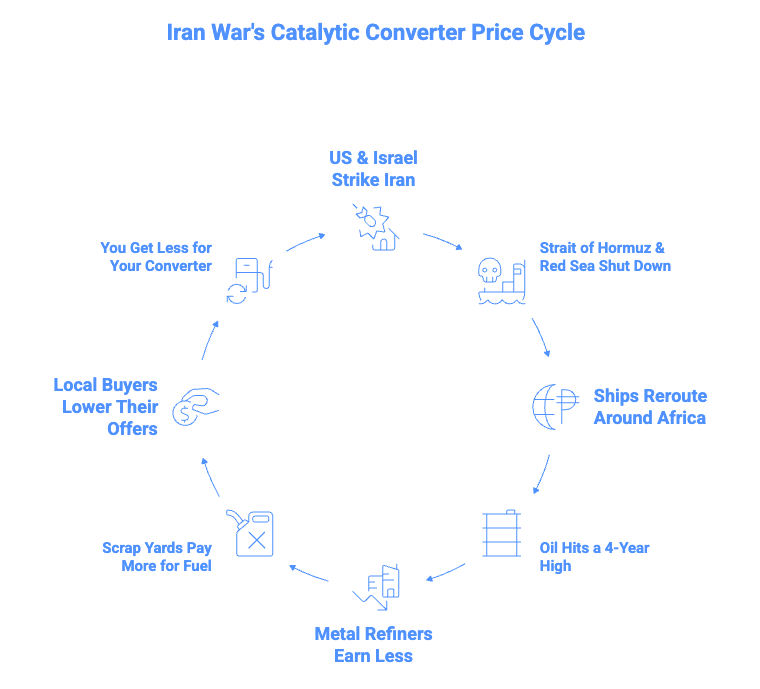
The closures in the Red Sea and the Strait of Hormuz are putting pressure on the companies that process catalytic converters. When those companies earn less, they pay scrap yards less. And when scrap yards earn less, they pay you less.
It works like this. The companies that melt down and process converters sell the platinum, palladium and rhodium they extract to buyers around the world. A lot of those buyers are in Asia and the Middle East. Those shipments used to go through the Red Sea. Now that route is closed or costs a lot more. Hapag-Lloyd is already charging $1,500 extra per container. Processing companies earn less on every sale. They respond by paying scrap yards less per converter. Scrap yards pass that cut back to sellers. That chain ends with you getting less money.
Most scrap yards in Wales and the South West are small businesses. They work with tight margins and they do not have the power to argue with a big refinery over prices. When the refinery says it is paying less, the small yard just accepts it – and then offers you less too. A yard in Cardiff or Truro cannot fight back the way a national buyer can. Choosing a buyer who skips that chain and prices directly from live market data makes a real difference.
| Step | What Is Happening | Who Pays | Effect on Your Cat Price |
|---|---|---|---|
| Strait of Hormuz closed | Ships forced around Africa | Shipping companies | Higher energy and export costs for refiners |
| Houthi attacks restart | Red Sea too risky for most ships | Shipping companies (add surcharges) | Adds $1,500+ per container, 10-14 extra days |
| Insurance jumps | War risk rates rising fast | Ship operators | Less money for refiners on every shipment |
| Oil hits $90-$100/barrel | Biggest rise in 4 years | UK petrol and diesel buyers | Diesel up for scrap yards within weeks |
| Yard fuel costs rise | Diesel more expensive | Scrap yard | They offer you less per converter |
| Refinery pays yards less | All of the above | Refinery cuts buying price | Your final price drops by roughly 4-9% |
Go directly to a national buyer who prices from live metal market data – not through your local yard and their refinery deal. Blancomet uses the same live pricing for Wales and the South West as for London. You should not get less just because of where you live.
If you sell larger volumes of catalytic converter scrap – as a yard owner, trader or EU exporter – the current situation calls for a few basic changes to how you work. The rules are simple: use a buyer who updates their prices every day, get quotes quickly, and do not sit on stock hoping prices will keep rising.
Since 28 February, metal prices have moved several percent in single days. Platinum jumped 2.7% in one day. Palladium moved by $124 per ounce in just three days. If you have a price agreed from two weeks ago, you are not selling at the current market. Use a buyer like Blancomet who resets prices daily.
Since the strikes on Iran, EU ports are checking metals shipments more carefully. If anything is missing from your paperwork – transfer notes, certificates, or anything else – your shipment could get stuck at the border for days. While it is sitting there, prices are moving. Get your documents in order before you ship. And before you agree any price, make sure you understand how catalytic converter values are calculated so you know what you are agreeing to.
It is tempting to hold stock and wait for prices to climb further. But during a war, prices can drop just as fast as they rise. Palladium actually fell on some days during the same week platinum was going up. The smart move is to get a quote, make sure it is valid for no more than 48 hours, and complete the sale. Waiting and guessing is a gamble.
| Risk | How Serious | What Is Happening | What to Do |
|---|---|---|---|
| Metal prices changing daily | Very High | Swings of 1-3% per day | Only use buyers with daily pricing |
| Strait of Hormuz closed | Very High | Almost no tanker traffic | Watch for ceasefire news |
| Insurance costs rising | High | Going up fast per BIMCO | Ask buyer to cover freight costs |
| Diesel getting more expensive | High | Oil at 4-year high | Fewer, bigger collection runs |
| EU customs taking longer | Medium | Extra checks at ports | Have all paperwork ready before shipping |
| Pound vs dollar | Medium | Dollar gaining as safe haven | Invoice in pounds where possible |
What is happening in the Middle East right now is directly changing the catalytic converter scrap price that UK sellers receive this week. The Strait of Hormuz is nearly shut. The Houthis are attacking ships in the Red Sea again. The biggest shipping companies have stopped sailing through the Gulf. Oil is at its highest price in four years. Platinum is up. Insurance costs are climbing.
All of that feeds into what a UK buyer can afford to pay you for a converter – through rising fuel bills, higher shipping costs, and the daily swings in platinum and palladium. Sellers who get a live quote today will do better than those relying on a price from last week.
It does not matter if you have one converter or a van full of them. The same rule applies: sell with a buyer who is working from today’s prices, not last month’s.
Contact Blancomet today to get a current quote.
1. How do the US-Israel-Iran war and Red Sea attacks change what I get for my catalytic converter? The strikes on Iran have pushed up the prices of platinum and palladium, sent oil prices to a four-year high, and made shipping more expensive across the world. All of that ends up affecting the catalytic converter scrap price offered to UK sellers – usually within days to a few weeks.
2. Why do sellers in Scotland get less than sellers in London? It costs more to transport converters from Scotland to a refinery – more fuel, more distance, more insurance. Those costs are rising fast because of the current oil price spike. The gap between what London sellers and Scottish sellers get is bigger in March 2026 than it has been for years.
3. Where can I get the best price for my catalytic converter right now? Use a buyer like Blancomet who updates their prices every day based on real platinum, palladium and rhodium market rates. Buyers with a fixed weekly or monthly price list are probably paying less than the current market – and that gap is larger than usual right now.
4. What metals are in a catalytic converter and why does a war in the Middle East affect their price? Catalytic converters contain platinum, palladium and rhodium. Most of these metals are mined in South Africa and Russia. When the Middle East goes into crisis, oil prices rise, energy costs go up for everyone who mines and processes these metals, and investors buy precious metals as a safe bet – all of which pushes prices up and creates daily swings in what your converter is worth.
5. Should I sell now or wait? Sell now. Metal prices are high right now. But they can fall just as fast as they rose. Get a current quote from Blancomet and act on it. Waiting to try to time the market during a war is usually a losing game.

5 Rosemount Park Drive
Rosemount Business Park, Ballycoolin Dublin, D11 FVH2, Ireland