
Your old electronics can be turned into extra money: the printed circuit boards (PCBs), wiring, and components inside them hold recoverable precious metals that licensed recyclers pay for by weight and grade. In an age where technology evolves at the speed of light, electronic waste, or e-waste recycling, has become both an environmental priority and a genuine income opportunity. From outdated smartphones to obsolete desktop computers, the lifecycle of tech gadgets is getting shorter by the day, and that growing pile of electronic scrap does not have to be a burden. This guide shows how e waste recycling for cash actually works, what your items are worth, and how to do it responsibly in 2026.
How much you make depends on the type of device, its weight, and the live market price of the metals inside it, so payment is calculated per kilogram and by grade rather than per item. The most valuable component in most electronics is the printed circuit board (PCB), a treasure trove of precious metals including gold, silver, copper, and palladium. This is why recycling electronics for money rewards quantity and sorting: a clean, well-separated load of high-grade boards is worth far more than a mixed bin of whole devices.
The scale of the opportunity is significant. According to the Global E-waste Monitor 2024, the metals embedded in the world’s 2022 e-waste were worth around US $91 billion, including roughly US $15 billion in gold and US $19 billion in copper, yet most of that value was never recovered. Choosing scrap electronics recycling over the bin is how that value gets captured instead of lost to landfill. Demand is strong nationwide, and the cash for electronic scrap UK recyclers pay tracks live metal prices.
| E-waste item | Main recoverable materials | What drives the value |
|---|---|---|
| Printed circuit boards (PCBs) | Gold, silver, palladium, copper | Highest value by weight; grade depends on board type and gold content |
| Desktop computers | PCBs, copper, aluminium, steel | Dense boards, power supplies, and heatsinks add up quickly |
| Laptop computers | PCBs, copper, lithium cells | Compact but metal-rich circuitry |
| Smartphones and tablets | Gold, copper, rare earths | High turnover means large recoverable volumes |
| Scrap electric motors | Copper windings, steel | Priced mainly on copper content and weight |
| Scrap starters and alternators | Copper, aluminium, steel | Steady value from copper and mixed metals |
Values are realised by weight and grade against live metal prices; an assay or sort determines the final figure rather than a fixed price per unit.
You can recycle almost any device with a plug, battery, or circuit board, but the items that pay best are those with dense circuitry or heavy copper content. E-waste encompasses a broad range of electronic items that are no longer in use or have reached the end of their lifecycle, from household appliances to industrial equipment. If you want to sell e waste, it helps to know which categories carry the most recoverable material. Even bulky items have value: recycling TV for cash is common, with the payout coming mainly from the boards and metals inside the set.
At Blancomet, we specialise in recovering value from the following:
The value of your e-waste is assessed in two stages: a quick visual grading, followed, where the load is large or valuable, by laboratory testing that measures the metals precisely. Two circuit boards that look similar can be worth very different amounts, and the difference is usually in how they are inspected, sampled, and analysed.
Visual grading is the fast first pass. A trained sorter reads the features that tend to track with metal content, with no chemistry involved. Common cues include:
Grading is quick and cheap, but it is only a proxy for what is inside. Miniaturisation can fool the eye: a small board can be metal-rich, while a large one can be surprisingly low in target metals.
When a load is large, mixed, disputed, or valuable, recyclers move from grading to measured testing. A representative sample is taken by combining many small increments from across the load, rather than grabbing the best-looking boards, then a portion is dissolved through acid digestion into a liquid. That liquid is analysed using Inductively Coupled Plasma Optical Emission Spectroscopy (ICP-OES), a method that measures many elements quickly and estimates the metal content across the batch. Good sampling matters more than fancy equipment: if the sample does not reflect the whole load, the result will not either. Clear documentation – photos, weights, and sample IDs – reduces disputes and makes a valuation easy to repeat.
The process turns mixed electronic scrap into clean, recoverable metal streams through a series of controlled steps. It begins with collection and ends with refined materials returning to the supply chain. Understanding how do we recycle electronics helps you prepare a cleaner load and get a better price.
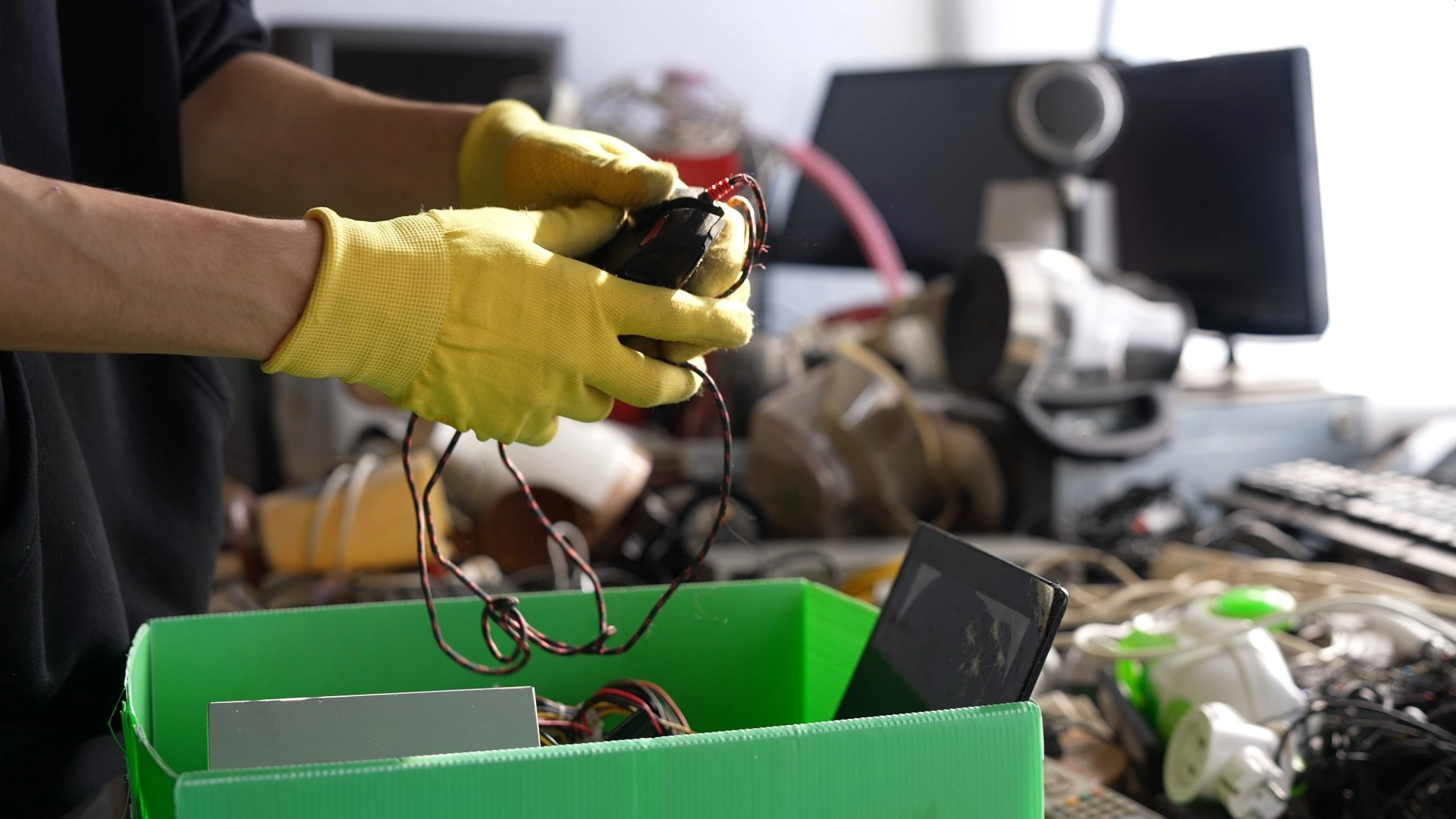
Preparing your e-waste well means it is sorted faster, valued more accurately, and handled safely, and it protects your data. Work through these steps before drop-off or collection:
For consumers, the goal is simple: protect your data, separate your items, and use an authorised recycler so the materials are recovered properly. A few habits make recycling safer and more rewarding.
For businesses, responsible e-waste handling is both a compliance duty and a cost-recovery opportunity. In the UK, the Waste Electrical and Electronic Equipment Regulations 2013 (WEEE Regulations) place obligations on companies that manufacture, import, or supply electrical equipment, and businesses placing more than 5 tonnes of equipment on the market each year must join a producer compliance scheme, as set out in the UK Government’s WEEE guidance.
| Step | Consumers | Businesses |
|---|---|---|
| Data security | Wipe devices and factory reset | Certified data destruction with certificates |
| Sorting | Separate by item type at home | Documented segregation and storage policy |
| Who handles it | Authorised local recycler | Certified treatment facility under WEEE |
| Records | Optional receipt | Audit trail retained (often 4 years) |
| Main benefit | Cash plus responsible disposal | Compliance, cost recovery, and reporting |
Most business e-waste is governed by three overlapping rule sets: the WEEE Regulations, hazardous waste controls, and data protection law. Handling all three correctly is what keeps a disposal lawful, safe, and audit-ready.
In the UK, the WEEE framework sets out who must register, how collection and treatment are managed, and what evidence proves recycling and recovery; the official overview is the UK Government’s WEEE regulations guidance. Ireland runs its own WEEE system, overseen by the Environmental Protection Agency; if you operate in Ireland or ship from the UK to Ireland, review the EPA’s WEEE compliance pages. Many e-waste streams also contain hazardous components – batteries, older display glass, boards with heavy metals – that trigger hazardous waste controls on storage, packaging, labelling, and transport. Finally, GDPR and UK data protection law apply to anything that can identify a person, so data-bearing devices must be securely erased or destroyed, with proof kept.
Paperwork is what proves compliance. Keep waste transfer notes (with the European Waste Catalogue, or EWC, code) for non-hazardous e-waste, hazardous waste consignment notes for hazardous fractions, copies of carrier licences and site permits, certificates of data erasure or destruction, and recovery statements. UK producers commonly retain these records for at least four years. Most enforcement – improvement notices, fines, or in severe cases prosecution – traces back to poor classification, missing notes, unlicensed carriers, or gaps in data-erasure evidence. For an end-to-end service, Blancomet offers e-waste recycling with reporting, and non-ferrous scrap metal recycling for the metal fractions, both with proper documentation.
From October 2026, businesses in England and Wales will need a digital record of waste movements, not just a collection booking and a folder of loose paperwork. Digital waste tracking turns each IT disposal – a monitor clear-out, a server-room refresh, a batch of broken laptops – into a recorded workflow with named parties, dates, item descriptions, and a clear handover trail. According to the GOV.UK digital waste tracking service, waste record keeping is moving onto a single digital service, and late or poor records can lead to fixed penalty notices of GBP 300 or more.
This reaches beyond compliance staff. IT identifies the devices leaving service, facilities arranges access and collection, finance checks approvals and cost, and site managers confirm what actually left. One owner should lead the process, even though several teams feed the record.
| Team | Main role | What they should have ready |
|---|---|---|
| IT | Identify devices leaving service | Asset lists, serial numbers, data-wiping status |
| Facilities / Estates | Arrange access and collection | Pickup point, dates, contacts, storage details |
| Finance | Check approvals and record quality | Approval route, cost code, audit trail |
| Compliance / HSE | Oversee legal record keeping | Policy, retention plan, escalation route |
| Site managers | Confirm what leaves site | Counts, photos if needed, signed handover |
To get ready, register early on the DEFRA system: name an account owner, set up the organisation account, add all active sites, create user roles, add your waste partners (carriers, recyclers, and receiving sites), test a sample movement, and agree who confirms that collection and receipt records match. The strongest records connect three things – what left, who took it, and where it went next.
Recycling e-waste keeps valuable metals in circulation and toxic substances out of the environment, while returning money to the person or business that recycles. The case is hard to ignore: the Global E-waste Monitor 2024 reported a record 62 million tonnes of e-waste generated in 2022, with only 22.3% formally collected and recycled. The rest, along with the metals inside it, was largely lost to landfill or informal handling.
Recovering those materials through proper e-waste recycling reduces the need for destructive mining, cuts pollution, and conserves finite resources. Mining virgin platinum group and precious metals is energy-intensive and damaging, whereas recovered metals re-enter the supply chain for new electronics, components, and industrial uses. Choosing to recycle is a financial decision and an environmental one at the same time.
The environmental case is not only about lost value; it is about what escapes when electronics end up in landfill or are burned. Discarded devices can release lead, mercury, cadmium, and brominated flame retardants, which contaminate soil, water, and air and pose real risks to wildlife and human health. Handling devices through a licensed processor keeps these substances contained and dealt with safely, which is one of the strongest reasons never to bin old electronics with general waste.
Repairing an electronic device almost always makes more financial and environmental sense than replacing it, because most of a device’s lifetime carbon footprint is locked in at manufacture. Producing a single laptop generates roughly 263 kg of CO2 equivalent, and for a smartphone, manufacturing accounts for the large majority of its footprint. The UK is among the highest producers of e-waste per person, at roughly 23.9 kg per head each year, and much of that is avoidable.
The numbers favour repair. Repair-sector research (London Recycles) estimated that Londoners spent close to GBP 3 billion replacing repairable items in a single year, more than GBP 450 per person. A refurbished smartphone typically costs 20 to 50% less than a new one, and a screen or battery repair is a fraction of a replacement. The table below compares typical UK costs and carbon savings.
| Device | Avg. repair cost | New device cost | CO2 saved by repair | Lifespan extension |
|---|---|---|---|---|
| Smartphone | GBP 50-150 | GBP 400-1,200 | 45-55 kg CO2 | 2-3 years |
| Laptop | GBP 80-250 | GBP 500-2,000 | 150-260 kg CO2 | 3-5 years |
| Tablet | GBP 60-180 | GBP 300-1,000 | 70-100 kg CO2 | 2-4 years |
| Games console | GBP 40-120 | GBP 300-500 | 40-80 kg CO2 | 3-5 years |
Source: Global E-waste Monitor 2024 and repair-sector research (London Recycles, Restart Project); figures are indicative.
When a device truly cannot be saved, that is the moment to recycle it, recovering its metals rather than sending them to landfill.
The shift to remote and hybrid working has quietly increased both household and business electronic waste. As employers issued laptops, monitors, and webcams and staff upgraded home offices, older devices became surplus faster than before. That extra turnover deepens the e-waste problem unless the retired kit is reused or recycled rather than binned. Businesses can soften the impact in three ways: extend device lifespans through maintenance and refurbishment, run take-back or buy-back schemes so old company kit returns for recycling, and give employees clear guidance on responsible disposal and drop-off options.
You can recycle e-waste for cash at an authorised recycler that prices by weight and grade and provides proper documentation. Blancomet operates across the UK and Ireland, with facilities in Stone, St Albans, Leeds, Dunfermline, Gateshead, and Dublin, so dropping off or arranging collection is convenient wherever you are based. Professional e waste recycling pairs a fair, weight-based price with safe, compliant treatment, and reputable e scrap buyers assess each load by metal content and grade rather than paying a flat rate. If you have been searching for cash for electronic scrap near me, a regional facility means shorter transport and a faster, fairer settlement.
Whether you are an individual with a single laptop or a business with regular volume, an authorised recycler gives you a transparent, weight-based price and a compliant audit trail. If you want to sell e waste near me, contact your nearest Blancomet site for a quote and collection options. Selling electronic scrap for cash works best when the load is sorted by type before drop-off.
Your old electronics are not rubbish; they are a store of recoverable metals and a small, repeatable source of income. By sorting your items, protecting your data, and working with an authorised recycler, you turn electronic scrap into money while keeping valuable materials in use and out of landfill. Ready to recycle? Explore Blancomet’s e-waste recycling service or contact your nearest UK or Ireland site for a quote.
Electronics are recycled by collecting and sorting devices, dismantling them, removing hazardous parts, and then using mechanical and chemical separation to recover metals such as gold, copper, and palladium. The recovered materials are refined and returned to manufacturing. Preparing a sorted, data-wiped load before drop-off speeds the process and improves the price.
You can often get paid to sell old tv units for scrap, though value depends on the type. Older sets contain recoverable copper and circuit boards, while flat screens are priced mainly on their boards and metals. Some panels carry handling costs, so an authorised recycler will quote based on the specific model and weight.
Laptop value comes from its circuit boards, copper, and battery cells, so laptop recycling for money is usually priced per unit or by weight against current metal prices. A clean, intact laptop with its board present is worth more than a stripped chassis. Wipe your data first, then ask a recycler for a current quote.
Scrap electronics are worth whatever the recoverable metals inside them are worth by weight and grade, which is why prices move with the gold, copper, and palladium markets. High-grade circuit boards pay the most, followed by copper-rich items like motors and cables. An assay or sort gives the precise figure.
You can sell e-waste at an authorised recycler with a regional facility. Blancomet has sites in Stone, St Albans, Leeds, Dunfermline, Gateshead, and Dublin, so wherever you search for a recycler near you, there is likely a location within reach for drop-off or collection.
Yes. Always erase personal data and perform a factory reset on any computer or smartphone before recycling. For businesses, use a certified data-destruction process and keep the certificate as part of your audit trail.
Yes, especially in volume. Single small items return modest amounts, but a sorted load of circuit boards, computers, or copper-wound motors adds up. Beyond the cash, recycling keeps valuable metals in circulation and meets environmental and, for businesses, legal responsibilities under the WEEE Regulations.
Scrap printed circuit boards (PCBs) are first graded visually by connector type, component density, and board category, then, for larger or mixed loads, tested in a lab. A representative sample is dissolved by acid digestion and analysed with Inductively Coupled Plasma Optical Emission Spectroscopy (ICP-OES), which measures the metals present so the batch can be valued accurately.
Yes. From October 2026, businesses in England and Wales must record waste movements through the UK digital waste tracking service rather than relying on paper notes alone. Register early on the DEFRA system, set user roles for your IT, facilities, and finance teams, and keep asset lists and carrier details together. Poor or late records can lead to fixed penalties of GBP 300 or more.
Repair is usually cheaper and far lower in carbon. A laptop repair typically costs GBP 80 to 250 against GBP 500 to 2,000 for a new device and can save 150 to 260 kg of CO2, while a refurbished phone costs 20 to 50% less than new. Replace only when a device cannot be safely or economically fixed, then recycle it to recover the metals.
Under the Waste Electrical and Electronic Equipment (WEEE) Regulations 2013, businesses that make, import, or supply electrical equipment have producer duties, and those placing more than 5 tonnes on the UK market each year must join a producer compliance scheme. You must use licensed carriers and permitted treatment sites, keep waste transfer or consignment notes, and hold proof of data destruction for data-bearing assets.
If electronics are sent to landfill or incinerated instead of recycled, they can release toxic substances such as lead, mercury, cadmium, and brominated flame retardants. These contaminate soil, water, and air and pose risks to both wildlife and human health, which is why e-waste should always be handled by a licensed recycler.

5 Rosemount Park Drive
Rosemount Business Park, Ballycoolin Dublin, D11 FVH2, Ireland