
Key Takeaways
Hybrid packs are heavy, high-voltage items. They can also be damaged without obvious signs. That mix makes end-of-life handling a safety issue as well as a compliance issue. In the UK, waste batteries sit under specific rules on treatment and recycling, which also affect how batteries get stored, moved, and documented. If you want the official wording, see UK government guidance on treating, recycling and exporting waste batteries.
It is end-of-life when it no longer delivers reliable performance, cannot be repaired in a practical way, or fails safety checks. Common signs include:
Sometimes a workshop can replace a small set of parts. Sometimes the sensible route is replacement. Either way, the removed pack becomes a controlled waste item that needs a proper next step.
A trained technician should isolate the high-voltage system, remove the pack using the right lifting and handling steps, and keep the unit stable during movement. After removal, the key goal is to prevent short circuits, damage, or heat build-up.
From there, hybrid battery disposal is less about throwing away and more about placing the pack into a safe chain of custody. That usually means protected terminals, suitable containment, clear labels, and a record of what left the site and when. If you run a garage, it helps to borrow thinking from other battery streams: keep batteries secure, document handover, and use responsible processors. Blancomet covers that wider duty-of-care mindset in The Importance of Responsible Lead Acid Battery Recycling.
Yes, but keep it short-term, controlled, and documented. Treat it as something you manage, not something you stash.
If you notice swelling, impact damage, or signs of overheating, stop and get specialist advice from your handler. Do not move it around just to tidy up.

Transport should follow the correct packaging and handling rules for batteries, based on condition and risk. A reputable collector will explain what they need from you and what they will provide, such as suitable containers and collection paperwork. For drivers, the practical point is simple: do not try to ship or courier a traction battery yourself unless the carrier explicitly accepts it and gives you clear packing guidance. For workshops and fleets, use a handler that takes battery safety seriously and can show you what happens after collection.
Shipping batteries for recycling was always a careful job, but in 2026 it became more uneven. New air transport limits for lithium batteries added another handling step for many consignments, while NiMH kept a simpler path. According to the ICC Compliance Center, relevant lithium battery air shipments must meet a 30% state-of-charge rule from 1 January 2026. That does not stop movement, but it adds work: a sender may need to discharge the battery, verify the level, document the condition, and confirm the carrier will accept the consignment.
This is where NiMH batteries now have an edge. They are not caught by the new 30% air charge limit, so planning is simpler, especially for the many older and mainstream hybrids that still use this chemistry. Separate handling guidance for nickel-metal hydride packs is set out by IATA. The real issue is handling friction: when one chemistry needs extra discharge control for air transport and the other does not, the simpler route tends to win for low-margin, time-sensitive recycling work.
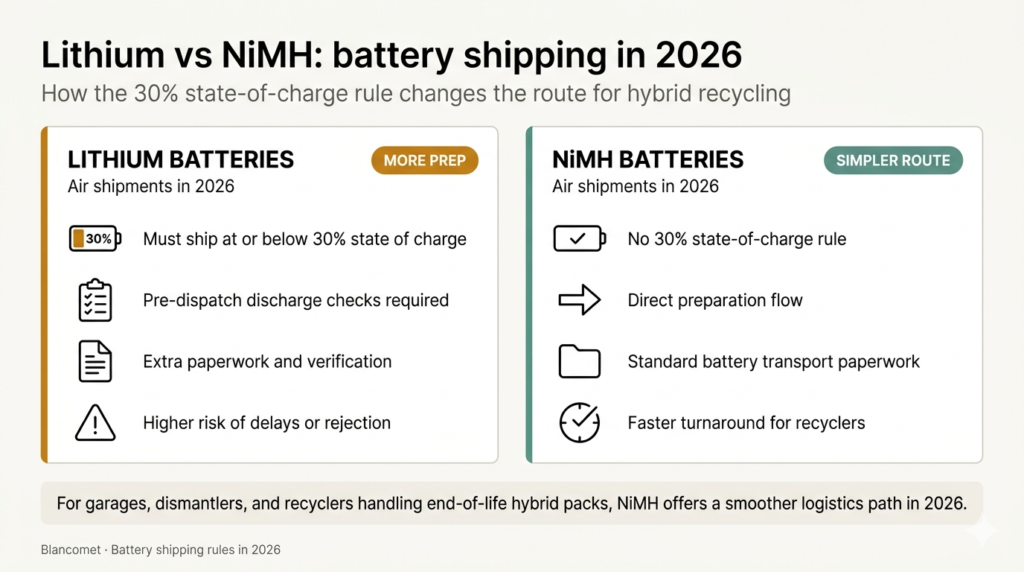
| Logistics point | Lithium batteries | NiMH batteries | Why it matters |
|---|---|---|---|
| Air shipment charge level | Relevant air consignments must meet the 30% state-of-charge rule in 2026 | Not subject to that same 30% rule | One route needs an extra pre-shipment control, the other does not |
| Pre-dispatch handling | May require discharge checks and extra verification | Usually a more direct preparation flow | Less prep can mean faster turnaround |
| Booking and acceptance | More likely to involve added review before flight | Often simpler to position for transport | Lower admin pressure helps small and mid-size senders |
| Mixed workshop stock | Needs clear separation and charge awareness | Still needs separation, but fewer air charge concerns | Sorting by chemistry becomes more important |
| Cross-border recycling planning | More sensitive to timing and route choice | Smoother where quick movement matters | Good for firms trying to avoid backlog |
The takeaway for lithium battery vs NiMH battery planning is that the difference shows up most at the dispatch stage. A garage manager cares which pack leaves the site with fewer calls, fewer checks, and fewer last-minute changes; in 2026 that is usually the NiMH pack. For a related view on whether a pack is even worth moving on, see Blancomet’s UK guide on whether to repair, recondition, or recycle a NiMH hybrid battery.
| Step | What to confirm | Why it helps |
|---|---|---|
| 1. Identify chemistry | Confirm whether the pack is NiMH or lithium | Prevents the wrong transport plan |
| 2. Record condition | Note visible damage, leaks, or missing parts | Gives the next handler clear information |
| 3. Protect against short circuit | Follow safe packing and terminal protection | Reduces avoidable risk in storage and transit |
| 4. Separate stock | Store different battery chemistries apart | Keeps dispatch decisions clear |
| 5. Confirm route | Check who is collecting, where it goes, and by which mode | Avoids last-minute delays |
| 6. Keep records | Maintain simple movement and collection notes | Supports traceability and handover |
This table shows the typical steps a hybrid pack goes through, plus simple checks that help you stay safe and compliant.
| Step | What usually happens | What you can check or ask for |
|---|---|---|
| 1) Removal | High-voltage system is isolated and the pack is removed with controlled handling. | Was removal done by a qualified technician? Was the pack kept stable and protected? |
| 2) On-site holding | Pack is placed in a safe holding area until collection. | Is it labelled, secure, and away from heat and foot traffic? |
| 3) Collection | A collector takes custody and loads the pack for transport. | Do you receive clear handover paperwork and collection details? |
| 4) Treatment | The pack is assessed and prepared for recycling through appropriate processes. | Can the handler explain the treatment route without vague answers? |
| 5) Recycling and recovery | Materials are separated and recovered into usable streams where possible. | Can they describe what is recovered and how outputs are managed? |
| 6) Records and reporting | Documentation supports duty of care and audit trails. | Can you keep copies of transfer notes and related documents? |
Most people picture recycling as a single action. For traction batteries, it is a chain of steps. Treatment facilities may dismantle packs, separate components, and process battery materials so they can be recovered as usable fractions rather than dumped as mixed waste. It also helps to remember that a hybrid pack is not just battery cells. It contains casings, wiring, and other parts that can flow into established recycling routes when handled correctly. If you want a plain-language view of what happens after metal collection, Blancomet explains the wider path in what can be done with scrap metal after it is collected.
There is no single right answer. It depends on the vehicle age, fault type, and how long you plan to keep the car.
If you plan to buy hybrid battery replacement options, keep the old pack within a compliant collection route. That way you avoid storage risks and you support proper treatment and recovery.
You should expect documentation that shows a clear handover of waste and a responsible next step. Exact documents vary by situation, but the principle stays the same: you want traceability. UK rules around waste battery handling focus on controlled treatment, recycling, and related responsibilities, with the clearest public reference point being the UK government guidance linked above.
Even when you recycle in the UK, policy and supply chains link to wider European changes. Recent EU-level updates focus on sustainability and responsible battery management across the battery lifecycle. For a high-level overview of that direction of travel, read the European Parliament overview of newer EU battery rules. It is useful context when you hear terms like battery passport or tougher reporting expectations.
Start with simple questions. If answers stay vague, treat that as a warning sign.
When you are ready to move an end-of-life pack into a controlled recycling stream, working with specialists who handle NiMH batteries can make the process simpler for both drivers and workshops, especially when you need clear logistics and paperwork. Many hybrids also keep a catalytic converter on the combustion engine, and that part holds separate value; Blancomet’s catalytic converter recycling service can handle it alongside the pack.
At end-of-life, a hybrid car battery should follow a safe, documented route: remove it correctly, store it securely for as short a time as possible, hand it over through compliant transport, and make sure it reaches proper treatment and recycling. In 2026, the air-transport gap between lithium and NiMH means sorting by chemistry early keeps the easy shipments easy. That protects people, supports recovery of useful materials, and keeps you on the right side of UK waste duties. If you need help with collection and processing for NiMH battery packs, Blancomet’s service team can guide you through the practical steps without guesswork.
1. Is a hybrid pack from an older car automatically waste?
No. Age alone does not decide it. A pack becomes waste when it is removed for disposal or it fails in a way that makes repair impractical or unsafe.
2. Can I leave a used hybrid battery at a normal scrap yard?
Do not assume you can. Traction batteries need controlled handling and the right treatment route. Ask the site what battery types they accept and what paperwork they provide.
3. Do NiMH batteries need special handling compared with small household batteries?
Yes. A traction pack is larger, heavier, and higher voltage than typical household batteries. Treat it as a controlled waste item and use a handler that can manage collection, containment, and documentation.
4. Can I ship a NiMH battery by post or courier in the UK?
It depends on the condition. New NiMH batteries in original unopened retail packaging can be sent by most UK couriers under standard battery rules, but used packs, damaged packs, and full hybrid battery packs are classified as restricted dangerous goods and should be moved by a licensed battery waste carrier with proper documentation. NiMH is generally safer to ship than lithium, but it still needs correct packaging to prevent short circuits.
5. Are NiMH hybrid batteries a fire risk like lithium batteries?
NiMH batteries generally carry a lower fire risk than lithium because their chemistry does not undergo thermal runaway in the same way. Even so, damaged or short-circuited cells can release heat and hydrogen gas, so terminal protection, dry storage, and separation from other chemistries remain essential. The lower hazard profile is one reason NiMH air shipments do not carry the 30% state-of-charge rule that applies to lithium consignments in 2026.
6. Are NiMH batteries regulated for road transport (ADR) in the UK?
NiMH batteries face far lighter ADR controls than lithium batteries. Most intact NiMH hybrid packs can move under standard waste battery transport requirements rather than full dangerous goods rules, provided they are packed to prevent short circuits and visible damage. Damaged, leaking, or thermally compromised packs require specialist transport and extra paperwork, so always confirm classification with your licensed carrier before booking.
7. Does a garage need a waste carrier licence to handle hybrid batteries in the UK?
A garage does not normally need a waste carrier licence to store removed hybrid batteries on its own premises, but it does need one (or a registered exemption) to transport waste batteries to a recycling site itself. Most garages avoid this by booking a licensed waste carrier or partnering with a battery recycler directly, which removes the in-house compliance burden and ensures hazardous waste consignment notes are handled correctly.
8. What should I keep for my records after handing over a NiMH battery?
Keep any transfer documents you receive, plus the collection date, the collector’s details, and a reference that links the pack to the vehicle or job. This helps with traceability if questions come up later.
9. Will replacing the pack affect what happens to the old one?
It should not. Whether you replace with a new, refurbished, or repaired option, the removed pack still needs a compliant route for treatment and recycling. The key is to avoid informal storage or untracked handovers.

5 Rosemount Park Drive
Rosemount Business Park, Ballycoolin Dublin, D11 FVH2, Ireland