
Because lithium air transport now carries a stricter charge limit. That adds work before a shipment can leave the sender.
According to the ICC Compliance Center, relevant lithium battery air shipments are subject to the 30% state-of-charge rule from 1 January 2026. That does not stop movement, but it does change the workflow. A sender may need to discharge the battery, verify the level, document the condition, and make sure the carrier will accept the consignment.
For large battery producers, that can be built into routine operations. For garages, salvage firms, and recyclers, it can be more awkward. End-of-life packs do not always arrive in neat batches. They show up when vehicles are dismantled, when a repair is uneconomic, or when storage space runs short. Each extra transport step can slow everything down.
The main change is simple: some lithium batteries now need to be moved at or below 30% state of charge by air. That creates another check before dispatch.
In practical terms, that means the shipper may need to confirm battery status before booking space. It can also affect routing. If an air option becomes harder to use, firms may need a different carrier, a different timetable, or a different processing site. Those changes cost time even when they do not show up as a line item on an invoice.
It matters because recycling logistics run on timing. If the pack sits too long, storage pressure grows and collection plans get messy.
A removed hybrid car battery pack often sits in a workshop or yard only because the next step is not yet fixed. When the route is clear, the pack moves out, risk drops, and stock control gets easier. When the route is unclear, the business carries the burden. That is why transport rules can change the economics of recycling even when the chemistry itself has not changed.
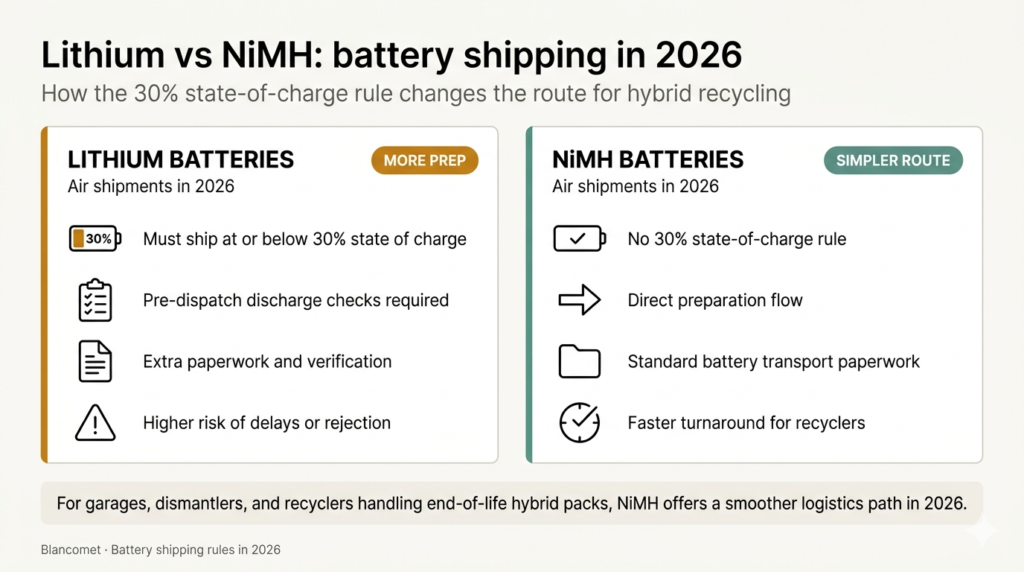
In 2026, lithium air shipments require a 30% state-of-charge check and additional verification. NiMH packs skip both steps — which is why they offer a faster, simpler route for hybrid battery recycling.
They have an edge because they are not caught by the new 30% air charge limit that affects lithium batteries. That can make planning simpler for recycling shipments.
The difference is especially clear in end-of-life hybrid streams. Many older and mainstream hybrid vehicles still use NiMH chemistry. When those packs need to move for treatment or recovery, the sender is not working around the same state-of-charge air rule that now applies to many lithium consignments.
Separate handling guidance for nickel-metal hydride batteries is set out by IATA. For recycling logistics, that difference is more than a technical note. It can affect how fast a load is accepted, how much checking happens before dispatch, and how easy it is to combine collection schedules across sites.
This is why 2026 changes the balance. The real issue is not only chemistry. It is handling friction. When one battery type needs extra discharge control for air transport and the other does not, the simpler route tends to look better for low-margin, time-sensitive recycling work.
The gap shows up in preparation, booking, and the chance of delay. A simple side-by-side view makes that clear.
| Logistics point | Lithium batteries | NiMH batteries | Why it matters |
|---|---|---|---|
| Air shipment charge level | Relevant air consignments must meet the 30% state-of-charge rule in 2026 | Not subject to that same 30% rule | One route needs an extra pre-shipment control, the other does not |
| Pre-dispatch handling | May require discharge checks and extra verification | Usually a more direct preparation flow | Less prep can mean faster turnaround |
| Booking and acceptance | More likely to involve added review before flight | Often simpler to position for transport | Lower admin pressure helps small and mid-size senders |
| Mixed workshop stock | Needs clear separation and charge awareness | Still needs separation, but fewer air charge concerns | Sorting by chemistry becomes more important |
| Cross-border recycling planning | Can be more sensitive to timing and route choice | Can offer a smoother path where quick movement matters | Good for firms trying to avoid backlog |
lithium battery vs NiMH battery planning differs most at the dispatch stage. One route now needs closer charge control for air shipment, while the other usually does not.
That changes daily operations. A garage manager may not care which chemistry is harder in theory. They care which one leaves the site with fewer calls, fewer checks, and fewer last-minute changes. A recycler thinks in similar terms. If a consignment arrives with fewer transport complications, intake planning gets easier.
There is also a staffing angle. Many workshop teams are not dangerous goods specialists. They can follow process, but the process needs to stay clear. If the rule set grows heavier for lithium and stays lighter for NiMH, the simpler stream will often fit smaller teams better.
That does not mean every lithium route becomes impractical. It means the gap has widened. For end-of-life hybrid collections, the transport burden now falls less evenly across chemistries than it did before January 2026.
Yes. Many hybrid vehicles reaching dismantling age still use this chemistry. That keeps NiMH relevant in real recycling volumes.
Many older hybrids on UK roads were built around nickel metal hydride packs. Those vehicles are now moving deeper into end-of-life territory. As a result, workshops and recyclers continue to see steady volumes of retired hybrid packs that are not lithium based.
If you want a fuller view of how that stream is handled after removal, Blancomet has a useful guide on what happens to a hybrid battery at end of life in the UK. That matters here because transport is only one step in a longer chain. Collection, storage, treatment, and material recovery all depend on the pack reaching the right place without delay.
For firms that manage several waste streams at once, this is good news. They do not need to treat every retired hybrid pack as if it sits under the same logistics burden as a lithium battery shipment. Correct identification at intake can save time all the way through the process.
Because one wrong assumption can create the wrong transport plan. Sorting first keeps the rest of the chain cleaner.
A workshop may receive batteries from hybrids, EVs, auxiliary systems, and general scrap vehicles. If those items are grouped loosely, the dispatch team can lose time checking what should have been known at the start. Clear separation by chemistry helps storage, labeling, and onward routing. In 2026, that matters more because lithium air rules now create a sharper operational split.
They should identify the chemistry, record the pack condition, and store it safely before collection. Clear prep prevents confusion later.
If your site sees a steady stream of removed packs, a specialist route for NiMH batteries can help keep storage times down and paperwork easier to manage. The aim is simple: know what you have, keep chemistries apart, and make sure the receiving partner knows what is coming.
You do not need a complex system. You need a repeatable one. Most garages can improve results with a short intake routine and a single contact path for pickup or onward shipment.
The checklist should cover identification, condition, isolation, storage, and route confirmation. Short lists work better than long manuals.
| Step | What to confirm | Why it helps |
|---|---|---|
| 1. Identify chemistry | Confirm whether the pack is NiMH or lithium | Prevents the wrong transport plan |
| 2. Record condition | Note visible damage, leaks, or missing parts | Gives the next handler clear information |
| 3. Protect against short circuit | Follow safe packing and terminal protection steps | Reduces avoidable risk in storage and transit |
| 4. Separate stock | Store different battery chemistries apart | Keeps dispatch decisions clear |
| 5. Confirm route | Check who is collecting, where it is going, and by which mode | Avoids last-minute delays |
| 6. Keep records | Maintain simple movement and collection notes | Supports traceability and handover |
No. Easier does not mean unregulated. It means the route may involve fewer battery-specific transport hurdles.
Waste handling, storage, and export duties still matter. So do carrier rules and site safety controls. The win with NiMH is not a free pass. The win is that, for many consignments, there is one less major air freight constraint to work around when compared with lithium batteries in 2026.
In many cases, yes. Fewer handling steps often mean less admin and less waiting.
Cost in battery logistics is not only freight price. It is staff time, time in storage, booking changes, rejected pickups, and the knock-on effect of delayed processing. When a shipment route is simpler, those hidden costs tend to shrink. That can make a real difference for businesses that handle modest volumes and cannot afford stock to sit around.
There is also a planning benefit. If a recycler can rely on a steadier flow from workshops and dismantlers, intake scheduling improves. That helps the whole chain. It also supports better decisions earlier — when the onward route is clear, choosing whether to repair, recondition, or recycle each pack becomes easier. For a practical look at that choice, see Blancomet’s UK guide on whether to repair, recondition, or recycle a NiMH hybrid battery.
NiMH batteries fit well into that picture because the logistics case is stronger now than it was before the 2026 rule change. When transport gets easier, collection usually follows.
Small and mid-size operators may feel it first. They have less room for delay and less time for extra admin.
A large battery network can absorb added steps more easily. A local garage, breaker, or independent recycler often cannot. For them, the appeal of a smoother transport route is direct. It can mean less on-site storage, faster clear-outs, and fewer awkward consignments waiting for the right slot.
This is where the 2026 story becomes practical, not theoretical. A chemistry that travels with fewer air freight restrictions can be easier to collect and easier to move into the recycling chain. That is a strong operational point for any business dealing with retired hybrid packs across the UK and into wider European recycling routes.
The smartest response is to sort early and plan by chemistry. That keeps the easy shipments easy.
Start at intake. Train staff to separate lithium and NiMH packs as soon as they arrive. Record basic condition. Decide early whether the likely route involves air, road, or a mix. Then keep each stream with the right paperwork and contact path. Small process fixes matter more than big policy statements.
If your business handles hybrid end-of-life stock regularly, this is a good year to review how those packs move. The transport rules changed. Your workflow should reflect that. The firms that adjust fastest are likely to see cleaner yards, fewer delays, and more predictable recycling handovers.
The 2026 air transport shift has changed the balance between battery chemistries. Lithium shipments now face a harder charge-control step for relevant air movements. NiMH does not carry that same burden. For garages, dismantlers, and recyclers, that can mean a simpler route from removed hybrid pack to treatment site. The key is not to treat every battery stream the same. Sort by chemistry, keep records clear, and build a route that matches the pack in front of you. If your business is reviewing how to handle retired hybrid stock, Blancomet’s service focus on NiMH battery streams offers a practical place to start.
1. Are NiMH hybrid batteries classified as hazardous waste in the UK?
In the UK, NiMH hybrid batteries are managed as industrial batteries under the Waste Batteries and Accumulators Regulations 2009, which means they must be collected, treated, and recycled by authorised facilities rather than sent to landfill. They contain nickel and rare-earth elements including lanthanum, cerium, and neodymium, which both carry recovery value and pose contamination risks if disposed of incorrectly. Garages, dismantlers, and recyclers should keep NiMH packs separated from general waste at all times and store them with terminal protection until collection.
2. Can I ship a NiMH battery by post or courier in the UK?
It depends on the condition. New NiMH batteries in original unopened retail packaging can be sent by Royal Mail and most UK couriers under their standard battery rules, but used NiMH batteries, damaged packs, and full hybrid battery packs are classified as restricted dangerous goods and cannot be sent through normal post. Used hybrid NiMH packs should always be moved by a licensed battery waste carrier with proper documentation. NiMH is generally considered safer to ship than lithium, but it still requires correct packaging to prevent short circuits.
3. Are NiMH hybrid batteries a fire risk like lithium batteries?
NiMH batteries generally carry a lower fire risk than lithium batteries because their chemistry does not undergo thermal runaway in the same way. That said, NiMH packs are not risk-free — damaged or short-circuited cells can release heat and hydrogen gas, so terminal protection, dry storage, and physical separation from other battery chemistries remain essential during workshop storage and transport. The lower hazard profile is one reason NiMH air shipments do not carry the same 30% state-of-charge rule that now applies to lithium consignments in 2026.
4. Are NiMH batteries regulated for road transport (ADR) in the UK?
NiMH batteries are subject to far lighter ADR controls (European Agreement concerning the International Carriage of Dangerous Goods by Road) than lithium batteries. Most intact NiMH hybrid packs can move under standard waste battery transport requirements rather than full dangerous goods rules, provided they are packed to prevent short circuits and visible damage. Damaged, leaking, or thermally compromised packs require specialist transport and additional paperwork. Always confirm classification with your licensed carrier before booking a collection.
5. Does a garage need a waste carrier licence to handle hybrid batteries in the UK?
A garage does not normally need a waste carrier licence to store removed hybrid batteries on its own premises, but it does need one (or a registered exemption) to transport waste batteries to a recycling site itself. Most garages avoid this requirement by booking a licensed waste carrier or partnering with a battery recycler directly, which removes the in-house compliance burden and ensures all hazardous waste consignment notes are handled correctly. The Environment Agency maintains the public register of approved carriers.

5 Rosemount Park Drive
Rosemount Business Park, Ballycoolin Dublin, D11 FVH2, Ireland