
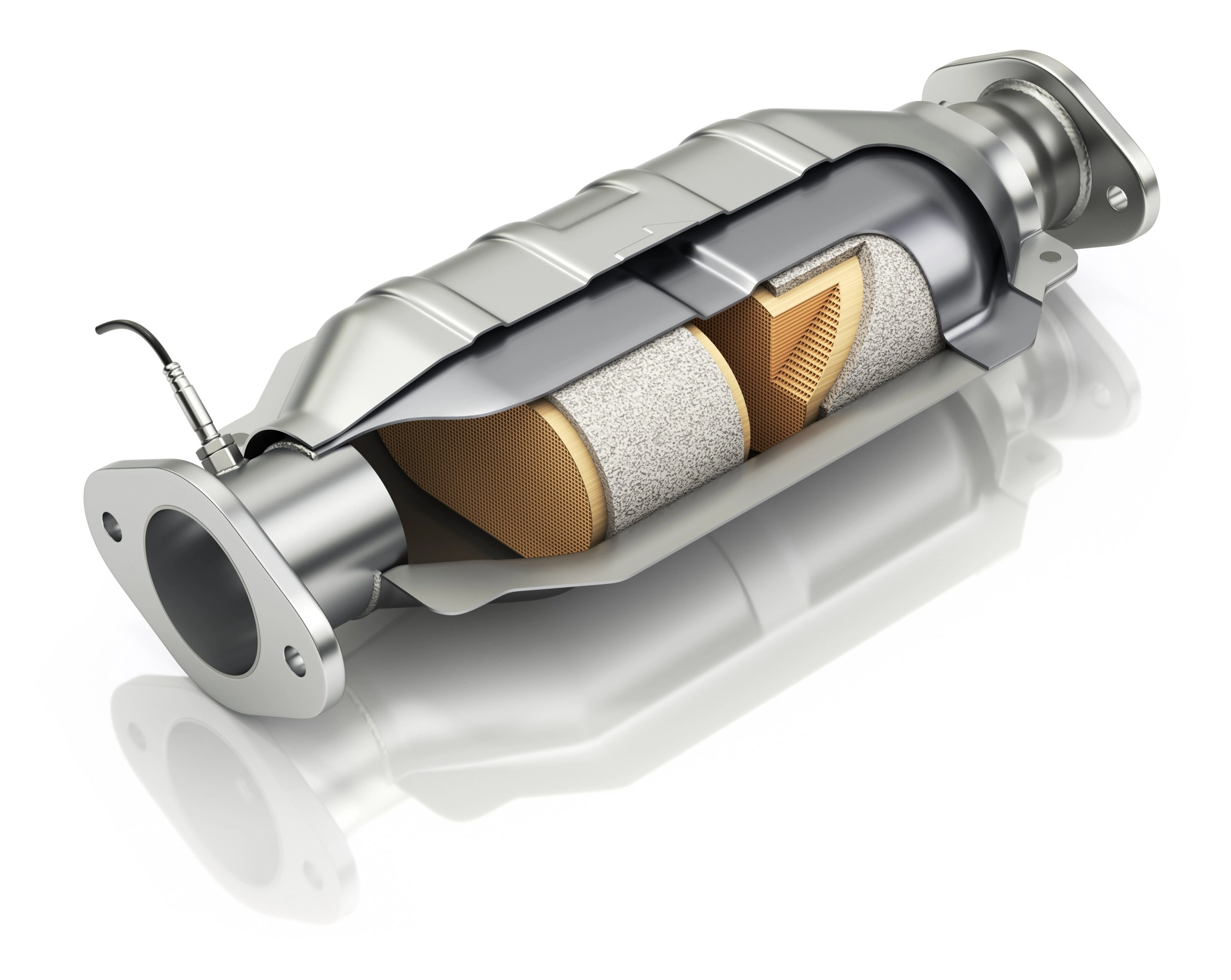
If you have ever wondered what’s inside a catalytic converter, the answer is both simple and impressive. From the outside it looks like a sealed metal part in the exhaust system. The inside of catalytic converter units, however, holds a carefully designed structure built to handle heat, guide exhaust gases, and support chemical reactions that make those gases less harmful. Knowing what the catalytic converter inside looks like helps you understand how the unit works, why it fails, why it is targeted by thieves, and why the catalytic converter price is so closely tied to the materials hidden within it.
According to Britannica, these devices reduce harmful exhaust emissions through catalytic chemical reactions rather than by simply filtering gases. That matters because many drivers assume the unit works like a basic trap, when in fact it works more like a reaction chamber: compact on the outside but complex within.
A catalytic converter is an emissions control device fitted to the exhaust of vehicles with an internal combustion engine. Its main task is to turn harmful emissions, such as carbon monoxide, unburnt hydrocarbons, and nitrogen oxides, into less toxic substances like carbon dioxide, water, and nitrogen before they leave the vehicle. Without it, exhaust would be far more dangerous to people and the environment, and populated areas would be far smoggier.
The first catalytic converters entered mass car manufacturing around the mid-1970s and quickly became standard on almost every petrol vehicle. Manufacturers place the converter between the engine and the muffler, because it needs high temperatures to work and that location heats up fastest. Some vehicles have more than one.
There are a few types. A simple two-way oxidation converter, common in older cars, turns carbon monoxide into carbon dioxide and converts unburnt fuel into water and carbon dioxide. Modern petrol cars use three-way converters that do all of that while also reducing nitrogen oxides, a major cause of air pollution. Diesel engines use different converters, often combined with exhaust gas recirculation (EGR), a diesel particulate filter (DPF), and selective catalytic reduction (SCR) to handle diesel-specific emissions.
So what are catalytic converters made of? The four core catalytic converter components are the outer shell, the substrate, the washcoat, and the precious metal coating. Together these parts of a catalytic converter turn a small canister into an efficient reaction chamber. The sections below break down the main components of a catalytic converter and the catalytic converter material used in each.
The external part is a shell made of stainless steel, designed to endure high temperatures and protect the inner components from heat, pressure, road debris, moisture, vibration, and sharp temperature changes. Without a strong outer shell, the internal core could crack, loosen, or fail much sooner.
The heart of the unit is the substrate, the core structure through which the exhaust gases pass. It is usually a ceramic honeycomb, although some modern converters use a metallic substrate. The honeycomb design provides a large surface area, enabling maximum contact between the exhaust gases and the catalyst. According to Corning, ceramic honeycomb substrates are built to provide high surface area while still letting gases flow efficiently. More surface area means more room for the reactions that clean the exhaust.
Before the precious metals are applied, a washcoat is laid onto the substrate. The washcoat, often made of materials such as aluminium oxide, silicon dioxide, or titanium dioxide, disperses the catalyst evenly and dramatically increases the usable surface area. It is easy to overlook, but it is one of the reasons a small unit can process so much exhaust gas.
The real work is done by the precious metals coated thinly onto the washcoat: platinum, palladium, and rhodium. Platinum and palladium mainly convert carbon monoxide and hydrocarbons into carbon dioxide and water, while rhodium is especially effective at reducing nitrogen oxides into nitrogen and oxygen. These metals are present in small amounts but are critical, and they are the reason an old or damaged converter still has value.
| Internal part | What it is | Why it matters |
|---|---|---|
| Outer shell | Stainless steel casing | Protects the internal structure from heat, pressure, and impact |
| Substrate | Ceramic or metallic honeycomb core | Gives exhaust gases a large contact area |
| Washcoat | Surface layer on the substrate | Spreads catalyst materials over more area |
| Platinum | Precious metal catalyst | Helps convert carbon monoxide and hydrocarbons |
| Palladium | Precious metal catalyst | Supports oxidation reactions in exhaust treatment |
| Rhodium | Precious metal catalyst | Helps reduce nitrogen oxides |
Understanding how are catalytic converters made explains why the inside is worth so much. Manufacturing starts with the substrate: a ceramic (usually cordierite) or metallic foil is formed into a thin-walled honeycomb with hundreds of parallel channels per square inch. The substrate is coated with a washcoat slurry that creates a rough, high-area surface. A precisely controlled amount of platinum, palladium, and rhodium is then applied and fixed by heat. Finally, the coated core is wrapped in a protective mat and sealed, or canned, inside the stainless steel shell. The exact metal loading is tuned to the engine and emissions standard, which is why two similar-looking units can hold very different amounts of precious metal.
Hot exhaust gases pass through the honeycomb channels and touch the metal-coated surface, where a series of oxidation and reduction reactions take place. Carbon monoxide becomes carbon dioxide, hydrocarbons turn into water and carbon dioxide, and nitrogen oxides are reduced to nitrogen and oxygen. It is not about trapping pollution; it is about changing the chemistry of the exhaust before it leaves the vehicle.
Modern converters work alongside oxygen sensors, often called lambda sensors, which measure the oxygen in the exhaust and help the engine keep the air-fuel mix close to ideal. One important detail: a converter has to warm up before it works well. At cold start it does very little, which is why a vehicle produces most of its pollution in the first minutes after starting, and why short, cold trips are harder on emissions than longer drives.
Although the unit is built to last and often lasts about as long as the vehicle, it is not indestructible. Heat damage, contamination, melting, cracking, and physical impact can all reduce performance over time. Common warning signs include reduced engine performance, higher fuel consumption, a sulphur or rotten-egg smell, a check-engine light, a metallic rattle from the exhaust, or a failed emissions test. Driving without a working converter is illegal in most countries, increases pollution sharply, can damage other exhaust parts, and will fail an inspection. Blancomet’s guide on when you should replace the catalytic converter covers the symptoms in more detail.
A converter’s value depends mainly on its precious metal content, which varies with vehicle type, manufacturing year, and converter design. Not all converters are equal: hybrids typically contain the highest concentrations because their converters work hard through frequent engine starts and stops. The table below shows approximate metal content and value ranges by vehicle category; figures move with live metal prices and manufacturer specifications. For the bigger picture, see Blancomet’s guides on why catalytic converters are so expensive and what cars have the most expensive catalytic converters.
| Vehicle type | Platinum (g) | Palladium (g) | Rhodium (g) | Typical value range |
|---|---|---|---|---|
| Standard sedan | 2-4 | 1-2 | 0.5-1 | £80-£200 |
| Luxury sedan | 4-7 | 2-4 | 1-2 | £200-£500 |
| SUV / truck | 3-6 | 2-3 | 1-1.5 | £150-£400 |
| Hybrid vehicle | 5-9 | 3-6 | 1.5-3 | £400-£1,000+ |
| Diesel vehicle | 5-8 | 0.5-1 | 2-4 | £300-£800 |
To spot higher-value units, look at the manufacturer code stamped on the shell, the physical weight, the honeycomb density, and the vehicle origin (Japanese and European units are often higher grade than domestic models). The only way to know the true figure is an assay, since value is tied to the chemistry inside the substrate, not the weight of the steel.
Scrap catalytic converters come from individual vehicle owners, auto repair shops, scrapyards, auto dismantlers, and salvage facilities. According to the UK Environment Agency, the country produces over two million end-of-life vehicles each year, all needing proper recycling, so the supply is substantial.
The Scrap Metal Dealers Act 2013 requires dealers to verify the seller’s identity with photo ID, record vehicle registration numbers, obtain proof of ownership, keep detailed transaction records for three years, and report suspicious transactions. These rules tightened in response to the surge in converter theft. The British Metals Recycling Association publishes guidance for responsible trading. Payment for scrap metal must be traceable rather than cash, and you should never buy or sell a converter without proper documentation, as penalties for handling stolen goods can include heavy fines and imprisonment. Working with licensed scrapyards, repair shops, and legitimate catalytic converter buyers keeps you on the right side of the law and supports the circular economy.
Catalytic converter recycling recovers the precious metals through industrial processing, not by crushing the part and selling it as mixed scrap. The journey from a scrapped car to refined metal runs through five clear stages, and value can be lost at any step if the unit is handled poorly.
| Stage | What happens | Why it matters |
|---|---|---|
| 1. Removal | The failed unit is taken off the vehicle | Protects the material from loss, damage, or poor disposal |
| 2. Identification | The unit is checked by type, make, and likely content | Supports fair grading and cleaner batching |
| 3. Sampling | Material is prepared and assayed for platinum, palladium, and rhodium | Establishes the metal value accurately |
| 4. Refining | The metals are separated into purified streams | Turns waste-bearing material into marketable industrial metal |
| 5. Return to market | Recovered metals re-enter industrial supply chains | Creates the bridge from automotive scrap to new industrial uses |
Once refined, the metals are no longer thought of as car parts; they are industrial metals again. This is also why the catalytic converter price (the cost of fitting a working replacement) and the catalytic converter scrap price (the recoverable value in a removed unit) are two different things.
Recycling catalytic converters keeps critical metals in circulation and out of landfill. Recovering platinum group metals uses roughly 85% less energy than mining virgin material, reduces the need for destructive mining by a similar margin, and prevents heavy metals and ceramics from contaminating soil and groundwater. One often-quoted figure puts the water saved through recycling at around two million litres compared with mining and production. The recovered metals return to manufacturing to make new emission-control devices, electronics, and even jewellery.
There is an economic side too. In the UK and Ireland, the recycling sector has created jobs across collection, processing, and advanced metallurgy, driven by steady demand for recovered metals. Choosing to recycle through a specialist is both an environmental and a financial decision, completing the circular economy loop for automotive materials.
The story does not end at the exhaust. The platinum group metals recovered from a spent converter can re-enter the same supply chains that feed newer energy technologies. Platinum in particular is used in proton exchange membrane (PEM) fuel cells and some electrolyser designs, which makes it the clearest bridge between vehicle recycling and the hydrogen economy. As bodies like the International Energy Agency have highlighted, critical minerals play a central role in clean energy transitions, so recovered platinum is no longer just a scrap issue; it is a supply issue.
That does not mean every old unit becomes a fuel cell. Recovered metals move into broad industrial markets, and hydrogen is one destination among several. But a stronger hydrogen sector raises demand and the value placed on recycled platinum-bearing material, which is why recovering it well matters more than ever. Whether a failing unit should be cleaned, replaced, or recycled depends on its condition: a lightly fouled unit may be a maintenance issue, but a cracked, melted, or depleted substrate cannot be restored and is best recycled for its metal value.
The same metals that make a converter effective also make it a target. With rhodium having traded at extraordinary prices, peaking above $20,000 per ounce according to USGS data, thieves can remove a converter in under two minutes with a portable saw, causing far more damage than the few grams of metal are worth to them. SUVs and trucks are especially vulnerable because their higher ground clearance makes the converter easy to reach, and replacing a stolen unit can cost roughly 1,000 to 3,000 pounds once exhaust damage is included. Thefts spiked during the pandemic, and Europol has linked large-scale converter theft to organised crime groups moving stolen units across borders.
No method is foolproof, but these steps significantly cut the risk:
A few persistent myths put people off recycling. Here are four worth correcting.
Inside a catalytic converter there is far more than an empty chamber: a stainless steel shell, a ceramic or metallic honeycomb substrate, a washcoat that expands surface area, and precious metals that drive the chemistry of emissions control. Those same parts explain why the unit is valuable at end of life, why it is targeted by thieves, and why proper recycling matters, all the way through to the hydrogen economy. When a converter reaches the end of its life, recycling through a specialist recovers useful materials and supports a cleaner process from start to finish. Explore Blancomet’s catalytic converter recycling service or contact your nearest UK or Ireland site for a quote.
Inside a catalytic converter there is a stainless steel outer shell, a ceramic or metallic honeycomb substrate, a washcoat, and a thin coating of platinum, palladium, and rhodium. The metals trigger the reactions that turn harmful exhaust gases into safer ones.
A catalytic converter is made of a stainless steel casing, a ceramic or metallic substrate, a washcoat of materials like aluminium oxide, and precious metal catalysts. If you are asking what is a catalytic converter made of in terms of value, it is the platinum, palladium, and rhodium that matter most.
The main internal structure is usually a ceramic honeycomb substrate, though some converters use a metallic substrate. The precious metals sit on top of a washcoat applied to that substrate.
A honeycomb substrate is formed, coated with a washcoat, then loaded with measured amounts of platinum, palladium, and rhodium and fixed by heat, before being sealed inside a stainless steel shell. Metal loading is tuned to the engine and emissions standard.
It depends on the vehicle and metal content. A standard sedan unit might be worth roughly £80-£200, while a hybrid converter can exceed £1,000. The figure moves with live platinum, palladium, and rhodium prices, so an assay gives the most accurate value.
They contain valuable platinum, palladium, and rhodium and can be removed quickly with a saw, making them a target for quick cash. Shields, etching, secure parking, and alarms reduce the risk.
Even a failed unit still contains recoverable precious metals. Recycling recovers those metals using far less energy than mining, reduces pollution, and supports industries from automotive manufacturing to the hydrogen economy.

5 Rosemount Park Drive
Rosemount Business Park, Ballycoolin Dublin, D11 FVH2, Ireland